
To SNAFU With Uncle Sam
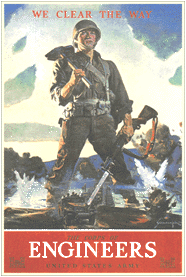
Being in the Army Engineers was a tough life, but after we were assigned to the Air Force, we could laugh thinking about the "GI's" eating fish sticks and mashed potatoes while we had fried shrimp or oysters and French fries for supper every Friday

The Years After The Big Ones
The Big Ones Were The Great Depression of the 1930's and WW II of the 1940's and through the early 1950's.
A laughable adventure as a guest of my Uncle Sam.
They Trained Us To Be Killers!!!
" The enemy finally found us and we begin throwing lighted fire crackers toward each other. "
The Last Farewell
T h e C o n t e n t s
I. The Night Train To San Antonio
Did you ever hear the armed forces term, SNAFU? It means "Situation Normal, All Fouled Up" or something like that. Anyhow, it describes my entire army career exactly. It was about the first of April in 1952, when the comedy started. That's when I got the letter from my uncle. My Uncle Sam, that is. It said, greetings from the President of the United States. I want to see your smiling face at the induction center, because you will be inducted into the U.S. Army on April 14, 1952.
We were loaded onto a train of Pullman cars that evening at the Southern Pacific Depot in Houston for the long journey to Fort Sam Houston in San Antonio. Sleepers for a 150 mile trip? Yep, that's the army way as you will see as this story unfolds. We had what was laughingly called a haircut and were issued uniforms during the week we were there.
It was at Ft. Sam that we had our first lesson in volunteering for jobs. Never volunteer, right? The sergeant had us in a ragged formation in front of the barracks. "I need 6 men to volunteer to go to the day room and watch the ball game." He yelled. Nobody moved. "Come on men I need those volunteers now." Two men finally stepped out of the formation. "OK, go through that door to the day room." Other men begin surging forward. "Get back in line, the rest of are going to get rakes and wheelbarrows and police (clean) the parade ground.
The sergeants finally taught most of the men to recognize their right foot and after a couple of days we could all start walking in the same direction at the same time. Turns were still difficult, but the "To the rear march." command caused a terrible mass of confusion with men stepping on each other. A couple of days on KP (kitchen police) rounded out the week and at the next morning's formation the sergeant started reading names from a long list. When he finished, he said everyone whose name was called, go in the barracks and get all of your gear. A couple of busses were parked outside when we came back out with everything we owned stuffed in a duffel bag.
The trip was uneventful except for the guy sitting by the wing who kept bringing the tiny stream of oil running across the wing to our attention. That was my first time to even be close to an airplane so I wasn't sure if the wing flapping was normal or not. No, that isn't a joke, the tips of the wing was actually flexing up and down a few inches, especially when we got into some turbulence over Oklahoma. Each time the plane dropped a couple of feet, you were left sitting in mid air above the seat. That brought out the seat belts in a hurry.
When we landed after a couple of hours and got out of the planes, it was evident that we didn't want to be there. It was a long ago abandoned, emergency air strip with grass growing in the cracks and not a human or a vehicle in sight anywhere. The sergeant found a phone somewhere and within an hour a few "Duce and a halves"(2 � ton trucks) pulled up beside us and we threw our duffel bags in and piled in beside them.
After a short trip we were driving through the buildings of Fort. Leonard Wood in Missouri. All of us ol' Texas boys were sniffing and saying "Pew Wee". It was the first time most of had ever seen or smelled coal smoke. Every building had a coal furnace and every mess hall had 3 or 4 coal cook stoves. It must have been close to hell in more ways then one. We finally stopped in front of some empty barracks we were met by a very small cadre, a couple of lieutenants and 3 or 4 sergeants. "I don't understand," the first lieutenant (his rank not his place in line) said, "you people are early, the rest of the men for the battalion won't be here until next week. It turned out that the empty barracks really were empty, no beds footlockers or anything so our first assignment as brand new draftees at Fort Leonard Wood was to go a supply room and get a load of cots, mattress, pillows, sheets, pillow cases and blankets so we would have a place to sleep that night. Another example of the army manner of thinking, but hold on there are many more.
We discovered that the small cadre, officers and noncoms in charge were almost all from a New Jersey National Guard unit that was called back to active duty. That meant that almost everyone from the Company Comander on down was there against their wishes. The cadre tried their best to be GI around us, but we could tell in a hundred little ways that they would rather be at home just like us.
"OK you guys, we are going to be something special." The first lieutenant, (who turned out to be our company commander) said from in front of the formation. We will be Company C of the 821 EAB. That is the 821 Engineer Aviation Battalion. It will be a SCARWAF unit. That's Special Category Army Reassigned With Air Force The armed forces is trying an experiment and you will be trained as army engineers. After the training is finished we will be attached to the U.S. Air Force and work on their projects under their direction.
Basic training must have been somewhat normal. You old soldiers already know about it and the civilians wouldn't believe how miserable it can be. I think it must be something like a woman having a baby. When she is going through it, she would gladly do bad things to her husband, but after a year or two, you only remember the very few good things and are ready to try it again. Think about it, June, July and August in a land so rough and hills so bad that they made 3 war movies on the base while I was there that were supposed to be taking place in Korea. We had one sergeant who was from the Philippines. He played a North Korean or Chinese solder as an extra in everyone of them. He got killed so many time during the filming that it wasn't even work for him. He just lay sprawled out on the ground and rested.
One of the really bad places was called Separation Hill. It separated the men from the boys. The road was straight up the side of the hill for roughly 2 miles at about a 30 degree angle. We had a few of the first army trucks to ever have an automatic transmission. No matter how fast they started at the bottom of the hill, none of ever reached the top without automatically downshifting all the way down to "Grandma" low low gear at about 3 or 4 miles per hour. We often used the wooded sides of Separation Hill for tactical problems.
During one night problem, half of the company was placed on the thinly wooded hill side just before dark. We were told that the enemy was going to attack and we had to defend the position at all costs. Then the sergeant issued the firecrackers to the smokers. Firecrackers you ask? We couldn't get blank ammunition for that problem so some of the cadre went to Waynesville (just outside the camp.) and bought a sack of firecrackers to make it more realistic. The other half of the company was positioned down hill, issued their firecrackers and told they had to find and wipe out the enemy position further up the hill. Defend the position at all costs, they had ordered. They didn't count on the logs we collected in the twilight. They finally found us and we begin throwing lighted fire crackers toward each other. But it was the logs rolling down the steep hillside that scattered the attackers and the defenders won the battle. Some of the sergeants were pretty upset about the logs, but they had ordered us to defend the site, so what could they say. Two of the men were missing when we fell in to return to the barracks. They were found under a tree, where they had slept through the whole problem. We slept in our bunks for the rest of the night while they dug foxholes under the barracks. The barracks was about 3 feet above the ground.
It was so hot and miserable during the day that a bunch of us would walk down to the Big Piney River in the evening and go swimming. Of course you had to stay under water up to your chin or the deer flies would eat you up. I thought gulf coast mosquitoes were bad until I discovered Missouri deer flies.
Shortly afterward, our company was assembling a portable aircraft hanger as a training project. It was a giant tent about the size of a football field that was strung on ropes between 2 lines of steel poles we had to erect and guy with cables. I was standing by with my shovel while a couple of the lieutenants and a handful of sergeants were studying a large blueprint. They argued back and forth for about five minutes over what the plan said to do. I had had a lot of drafting in school and couldn't help but see the answer. "Excuse me sir, could I make a comment?" I ask. "Sure, you may as well," he replied. After I explained the answer to the problem, he ask my name, then what my MOS was. The next Monday morning I was enrolled in carpenter school.
Things were more like normal after basic. We usually were off on Saturday afternoons and all day Sundays. I was in the barracks one Saturday afternoon, trying to decide how to spend the weekend when our sergeant walked in and said, "You're coming with me, you just volunteered to help on a little job. I followed him out and joined a small group of men beside the mess hall. "OK," the sergeant said, "we are going to mix a little concrete and pour a small slab for the garbage cans to sit on." Needless to say, it was about 2:00 AM Sunday morning when we finished and stumbled off to bed.
"The Company Commander decided that everyone who worked on the concrete slab project will get a 3 day pass this weekend." The sergeant announced at the morning formation. I caught up with the sergeant later and explained that my wife would be coming to Missouri in two weeks and ask if I could delay taking my 3 day pass until then. "Take it this weekend or loose it." he answered. The longer I thought about it the madder I got and Friday morning after I picked up my pass, I was standing on the side of Route 66 in a Class A uniform with my thumb stuck out. Eighteen hours later, I was 800 miles away knocking on my mother in law's front door in Houston. Nellie and I had a wonderful 24 hours together before I walked over to the highway and stuck my thumb out pointing north. I made it back to Fort Leonard Wood 2 hours before reveille Monday morning.
Just before Thanksgiving of 1952 the our unit, the 821 Engineer Aviation Battalion were transferred to Wolters Air Force Base (previously Fort Wolters) at Mineral Wells, Texas for advanced engineer training. The thing I remember most about Wolters was the fact that I could either catch a ride with a buddy or hitchhike to Houston every weekend to be with Nellie about 24 hours.
The second most memorable thing about Wolters was standing guard duty. We had a water plant set up in the woods by a creek that had to be guarded every night. I mean there must have been thousands of people waiting to steal a 1,000 gallon rubberized canvas water tank and a pump hidden miles out in the woods. That night when my turn came up, we were driving to the guard post when a cougar ran across the road in front of the jeep. When we arrived at the site the guard on duty handed me the flashlight and jumped into the jeep and they took off, leaving me standing in the dark watching the taillights disappear. After the jeep was out of sight I turned the flashlight on and was greeted by just enough of a very dim orange glow to see the flashlight itself. I remembered where the tank was located from seeing it in the headlights of the jeep. I stumbled toward it until I finally touched it's cold wet sides. I stood with my back against that cold wet surface for 2 solid hours while every wild animal in Palo Pinto County rustled through the dry leaves to drink from the creek a few feet away. Some of them lapped louder then a Great Dane dog and to me every one of them sounded like a very hungry giant cougar.
Then there was the guard post near the rock crusher. It was pitch dark, but I could see the lights from the rock crusher where the night crew was working. I was struck by a sudden attack of lonely and decided to walk over just close enough that I could watch the guys working for awhile and know I wasn't alone. I felt my way across a field that was studded with a few clumps of bushes here and there. Of course I couldn't use the flashlight because some at the crusher site would have seen it and probably reported seeing me. I was about halfway there when I walked up on some bushes. One of the spookiest noises I ever heard exploded right in front of my face. You bird hunters will know what I am talking about, when a whole covey of quail takes off it's an awesome sound. When you can only see by starlight and they roar up right in front of your face, the first few seconds are terror.
The ship made one stop at San Juan, Puerto Rico, where a group of Puerto Rican troops bound for Germany were loaded onto the ship. The ship sailed across the south Atlantic stopping first at France to let us off. The rest of that trip was very frustrating for an old southerner like me. Most of the Puerto Rican troops were black. For the next couple of weeks every time I said something to a black guy, expecting a soft southern drawl, I was inundated by a flood of Spanish.
The train dumped us in the little town of Druex (pronounced Drew, about 40 miles north of Paris), where the unit was dumped in the cold at the (already closed for the night) depot at 11:00 PM. After a phone call and an hour or so wait we were picked up in some open top, cattle type, trailers pulled by 18 wheel truck rigs and driven through the cold night to the new air force base that consisted of about sixteen squad tents, a mess hall tent, headquarters tent and a very large open prairie.
The official objective of our SCARWAF unit was to assist in building a NATO Air Force base in France. Our first and only job assignment there however, was to build permanent living quarters along with mess halls, supply rooms and offices for ourselves. The French civilian contractors had the airport construction sewed up and no American troops worked on it.
My platoon was sent to Leon (lay-on) after the first few weeks, where we constructed a service club building and movie theater building at the Leon Air force base. Our next assignment was at Chateroux where we assembled a prefab 10,000 barrel oil storage tank for the Chateroux Air Force Base in the fall and winter of 1953. It was often 10 or 12 degrees F. at noon that winter. The tank was built of steel plates bolted together with three rows of bolts at each seam. There was a neoprene gasket between the plates to seal the seams. We would carry brooms to the work site every morning to sweep the snow off of the material. We had to work wearing gloves to keep the wrenches, washers, nuts and bolts from freezing to our fingers when we picked them up
Back at Dreux the prefab buildings, that made up our base at Dreux were finished and heated by two fuel oil burning heaters. There was one near each end of the building sitting in a wooden box about 3 feet square and 6 inches deep. The box was full of sand and the heater sat on the sand. Outside each building near each end, there was a 55 gallon barrel of fuel oil on a high stand. A small hose running through the wall and across the floor brought the oil to the heater.
During the winter, in early 1954, it was getting almost time for us to get discharged and we were all getting anxious to go. It was freezing cold that night when the fuel oil started a tiny drip in one of the sand boxes in the headquarters building. Somehow the little puddle of fuel oil in the sand caught fire from the heater about 1:00 O'clock in the morning. The night CQ got a little bumfuzzled when he saw the little blaze. Instead of going outside and turning the oil off at the drum, he jerked the hose off the heater and started running for the door with the end of the hose in his hand. He reached the end of the hose before he reached the door. Then he decided he had run the wrong way, so he started toward the door at the other end of the building. He didn't reach that door but running back and forth with the hose squirting a big stream of fuel oil had pretty well covered the whole floor. The water was frozen in the fire truck, so everyone stood around and watched while the building burned to the ground along with every man's personnel record for the whole battalion.
II. Moving To Missouri
III. Separation Hill
IV. Back To School
After we finished our army basic training we started going to engineer training classes for our own MOS (Military Occupation Specialty). When the MOS list came out, I was listed as an explosive expert. I quickly looked up the sergeant over that department and told him how happy I would be to work with him and how bad I hoped my bad eye wouldn't allow me to make any mistakes. The next morning, my MOS had been changed to laborer. V. Hello Texas
VI. Goodbye Texas
We had finished our advanced engineer training at Wolters Air Force Base at Mineral Wells, Texas by the middle of March 1953. Someone genius in the Military Air Sea Transport department realized they hadn't shipped any troops out of Galveston since the end of W.W. II. So in late March of 1953, the battalion was loaded onto chartered busses and driven to Galveston, Texas and onto a pier where they boarded a troop ship named the USS General Haun. VII. Near The Reveria
When we got within sight of land near France, the sailors began shutting the waterproof doors below decks. When ask why, we were told it was because there were still a lot of mines in the harbor and sometime one floated free and was a hazard. As the ship approached France, that same Army genius decided that no soldiers had "went over the side" in France since World War II. After the ship anchored in the harbor at La Rochelle (near La Harve), the entire ship load of soldiers climbed down the landing nets hanging over the side of the ship. We stepped off the nets into "Ducks"(Landing craft) and were driven across the beach to a railroad siding where they were loaded into some French passenger train cars.