
Printed On Cheap Newsprint To Keep The Prices
GRANDPA
Low, The Pulps Were The Literature Of The Working
Class For The First Half Of The 20th Century


� 1937 Street & Smith Publications
Printed On Cheap Newsprint To Keep The Prices
GRANDPA
Low, The Pulps Were The Literature Of The Working
Class For The First Half Of The 20th Century
� 1937 Street & Smith Publications
One of my strongest memories of Grandpa Daut was of him sitting in the porch swing after supper. He would be absently mindlessly petting the big old tom tabby cat with one hand, while his other hand held the pulp western magazine that occupied his mind. Back in the 1930's and 40's the more affluent men in old Montgomery, Texas bought just about every western pulp magazine that was printed and after they finished them, they passed them on to the ones who couldn't afford them. The used westerns were traded back and forth among the men like comic books were traded among the boys.
Most upper and middle class citizens in the 18th century could afford to buy books and the more expensive slick magazines like "The Saturday Afternoon Post", "Colliers" and "Cosmopolitan" that offered fiction stories. The only cheap popular fiction for the working class began with the "Dime" novels. They were 32 pages long and stapled like a comic book. The price later dropped to a nickle. They were poorly written and written more for the younger and poorly educated readers. They contained stories like "Nick Carter, Master Detective" and "Buffalo Bill, Western gunman". The only other alternative to buying expensive books was the rental library. Almost every drugstore in Houston had a bookcase about 2 foot wide and 5 or 6 foot high, filled with hardback books. The books could be checked out and read for one week for only 10 cents.The pulp magazines began in 1896 when Frank Munsey's children magazine titled "The Golden Argosy" was beginning to founder. He renamed it "Argosy" and slanted it's contents toward a more mature readership. To offer a greater selection of fiction at the lowest possible price, he printed the new magazine on low quality, wood pulp paper to reduce costs as much as possible.
Other publishers noticing Frank's new success, quickly jumped onto the bandwagon with All Story, Top-Notch, Short Story, Blue-Book and Adventure. These general fiction magazines were soon followed by pulps specializing in one area of fiction such as detectives, westerns, science fiction, fantasy and romance. I have to laugh when I remember one romance pulp from the 1950's titled "Gay Romances". That was back when gay meant "Happy" and was without sexual connotation.

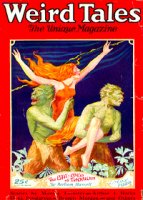
My personal favorites were the science fiction and fantasy pulps like "Weird", "Amazing Stories", "Wonder Stories", "Planet Stories", "Startling Stories" and "Captain Future". I don't guess I read the "Weird" pulp magazine above. It's the May 1928 issue and I was only two months old.
Even though their are still a few of the old pulp titles being published today, the beginning of the end started in the late 1930's when paperback books were introduced. The first ones I remember were called "Pocket Books" and sold for a quarter.
Web Site Links For Pulp Science Fiction
- This page is devoted to Weird Menace Pulps and Supernatural Detection.
- Here's a site devoted to Edgar Rice Burroughs, while this is a site devoted to his most famous creation: Tarzan of the Internet, which includes a few pulp resources.
- You can also read the Literary Works of Edgar Rice Burroughs, which are currently on-line.
- Here's a site devoted to Weird Tales - The Unique Magazine.
- There are an amazing number of web sites devoted to H.P. Lovecraft. You can turn to The H.P. Lovecraft Archive, or you can see other sites on any of the following three (three!) Web Rings: the Cthulhu Web Ring, the Mythos Web Ring and Jade Idol Web Ring.
- Cthulhu and H.P. Lovecraft -- This is another Lovecraft site (one of many, actually).
- The Robert E. Howard Archive -- All about the man behind Conan. You can also turn to JDrobin's Personal Home Page for more on Robert E. Howard. (If you want to read specifically about Conan, turn to the sites in the Conan Web Ring.)
- The Shrine of Clark Ashton Smith is devoted to the third member of the "holy trinity" at Weird Tales:
- Here's a page devoted to a later pulp fantasy writer, Fritz Leiber.
- The William Hero Collection -- SF pulp material from Virginia Tech. It comes with covers and complete reprints of several Science Fiction pulps.
- You can read about the most famous hero of the science fiction pulps at Century 25: Buck Rogers.
- Here's another page devoted to a hero in the sceince fiction pulps: Edmond Hamilton's Captain Future.
- Turn to these checklists for the great science-fiction magazines: Amazing Stories Listings, Astounding Stories Listings and Unknown Listings.
- '50's Sci-Fi Pulp Covers -- These are provided by the pulp dealer "Level 7."
- Sci-Fi Art Home Page
- Paskow Science Fiction Collection
- Time Tunnel -- The company sells Golden Age science fiction covers on CD-ROM.
- Science Fiction Resource Guide -- Just about any information you need about science-fiction.
- Finally, I quite like Arron Allston's page, Elements of a Popular Science Future.
- Adventure House provides this useful History of the Pulps.
- Here's another History of the Pulps, written by Michael Jarrett, an associate professor of English at Pennsylvania State University.
- Here's a site devoted to the Dime Novel Collection at Stanford.
- Here's another page devoted to Dime novels- story magazines and pulps.
- This page offers Bibliographic Information on Talbot Mundy, one of the great adventure writers in the early pulps.
- Here's The Page of Fu Manchu, one of the most famous villains of the early pulps.
 Page V