
|
|
We Meet Glen Lee Subdivision
The first time I saw lot number 194 was in the summer of 1957. Our friends and neighbors who lived across the street from us on Cromwell Street, had already paid down on a couple of lots in The Glen Lee Subdivision a few weeks earlier. Their lots were just east of number 194, We both wanted to get further away from the City of Houston. The City of Houston had just annexed across Little York Road to within 4 blocks of Cromwell Street. That was the deciding factor for us to follow the neighbors to the far distant suburbs.
We had sat down earlier and very carefully figured out exactly how much money we would have to have each month to live on, if we moved out here in the country. It came to about 10 or 15 dollars more then I was earning each month from the City of Houston. The payoff time on this house however, would only be 5 years while we still owed 28 years on the GI home on Cromwell Street. Besides, our neighbors, across the street on Cromwell Street had put their house up for sale and were going to move out here. So, of course we decided to try it.
We bought lots 194 and 195 in the Glen Lee Subdivision from the Archer Development Company's little real estate office at the corner of FM 525 and Lee Road. $495 each at $10 down and $10 a month on each lot.

This brand new little "Jim Walter" shell house looked great from the street. On the inside it was a different story. Rows of new bare two by four studs and the black tarpaper under the siding made up the outside walls. Rows of bare two by four studs made up the inside walls. The roof rafters and the underside of the roof decking served as the ceiling. Hey, the whole house had a giant cathedral ceiling before cathedral ceilings were the fashion.
There were 5 houses already in the neighborhood when we moved into our brand new little "Jim Walter" house on the prairie. The cows from the old dairy farm days had kept the land free of trees. The only thing living was grass, weeds, rabbits and horned toads. We could stand in the front yard and watch every vehicle traveling on Lee Road about 4 city blocks away. And we could see the Kafir Corn growing in the field on the west side of Lee road.
The streets were all made with crushed shell as a topping. All of the neighborhoods mailboxes were lined up in a row on Lee Road in front of the ice cream store. Ice Cream store, you ask? Yes, where the freight company was on Lee Road at Townsan Street
"The Neighborhood
A lot of folks don't realize that the original subdivision was about one third of it's present size. Section I, the original neighborhood only contained nine square blocks. There was only Townsan Shelburne, Boness and Glen Lee Streets crossed by Truxton, Saybrook and Ruston.
When section II was added between Glen Lee and the bayou we would hear the construction workers blasting the stumps out of the street right of ways with dynamite.
Townsan Street, between Ruston and Green Manor existed only as a pair of deep ruts to get to the "Pig Trail".
Green Manor Street from Townsan to Greens Road was known to most of us as the "Pig Trail". It was a little more defined. There were 3 or 4 sets of ruts through the grass. No one used the pig trail after a rain unless you had a friend who could pull you out.
When we moved into the little house on Boness Street, the gas mains hadn't been laid yet and the poles hadn't been set for HL&P's power lines. We had a hand pump on a 40 foot well, a Coleman Stove, kerosene lamps and a temporary outhouse hidden inside the chicken house (Deed restrictions).
"The Big Move
The thing I remember most about moving from the GI house on Cromwell Street to Humble, was the evening Dusty (my across the street neighbor)and I moved the chicken house. I had about 25 or 30 bantam chickens with a small yard and chicken house. The chicken house was about 6 feet wide and 12 feet long, built of lumber and about 7 feet high at the front He had an old model T chassis, no body or motor, that we pushed up beside my chicken house. We worked and struggled until we finally got the chicken house up on the chassis and tied it down.
We chained the model T chassis to the back bumper of his pickup truck and pulled it, chicken house and all, an extremely long slow 5 miles to our new home. Oh yes, I forgot to mention that I rode on the chassis to steady the chicken house in case it tried to shift on the old car frame. Hey, I didn't claim to be real smart, but we got it there in one piece. I quickly threw up a new fence and the bantams didn't even stop laying eggs. Nellie and I moved all the boxes and small things in our car and dusty and I moved the heavy furniture and things in his pickup.
A few weeks later we moved Dusty's stuff to his new house a couple of lots down from us. He also raised bantams, but he built himself a new chicken house and we didn't have to move his old one.
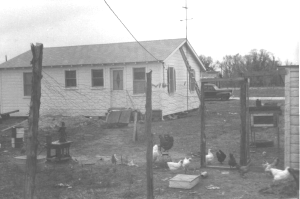
We didn't have electricity or gas until the lines were run some weeks after we moved. Of course no electricity meant no running water and no running water meant no bathroom. The deed restrictions stated NO OUT HOUSES, so of course we hid ours in one end of the chicken house.
Every time Nellie went to the outhouse she would take the shovel to fight off the bantam rooster. He loved to run up and try to flog her legs. For you city folks, that means it would try to stab her legs with his spurs. Every once in a while she would lay him out with the shovel. He would lay there for a few minutes after she whoped him upside the head. Then he would get up, shake his head and crow like he had just won the world's heavyweight championship. Man, that old bantam rooster had spunk. He also had very sharp spurs about 1 1/2 inches long.
"Country" Telephones
The telephones were through the "Home Phone Company" and calls between Humble and Houston were long distance. One of our biggest surprises after we finally got a telephone was when I stopped on the way home from work to use a pay phone. I stopped at the old Log Cabin Restaurant because it was the first pay phone in the Home phone area. I wanted to be the first one to call Nellie on our new telephone.
The pay phones used by Humble were what some people called the "Paranoia Pay Phones". Not knowing this, I dropped a nickel in the slot and dialed our new telephone number. Nellie answered, "hello . . . hello and I was hollering "hello . . . hello" and she hung up.
I dropped another nickel in and redialed. We went through the hello . . . hello routine again and she hung up.
Then I read the little sign I had lifted to get to the coin slot on the telephone. "Dial your number. When your party answers deposit your nickel and starting talking." Reading the directions first helps a whole lot.
"The First Years
POOR??? Lord, it hurts now to remember how poor we were in 1957 when we moved into the new little house on Boness Street.
It wasn't so bad that fall when we moved in. With all the windows open, any little breeze blew through. The first blue norther that blew across our little open prairie changed that. Try to picture this in your mind, Nellie and I sitting on the couch with David and John between us watching the old black and white TV. We had a blanket stretched across our laps. On the floor in front of us, under the other side of the blanket was an electric rotisserie oven (from better times) with some bricks inside.
After that we borrowed an old wood stove from a friend over in Westfield. A contractor was building a neighbor's house down the street a couple of lots about the same time. I'll bet they wondered about little elves who came during the night and picked all the wood scraps from the days work and hauled them away.
I became an expert at taping joints and floating sheetrock during that first year. Then Nellie had decided to have another baby and we needed one bedroom finished right away. Plumbing and electrical things had the highest priority and sheetrock was low on the list. Then I discovered the railroad siding off Hardy Street near Crosstimbers where building supply companies unloaded sheetrock from rail cars.
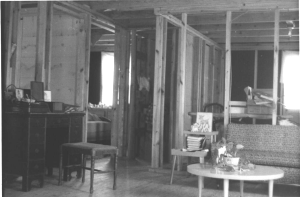
The sheetrock companies took about 6 pieces, a foot wide and 4 feet long and stacked them. A couple of nails or a little glue held them together. Then they put 3 or 4 stacks on the floor of the rail car and stacked full sheets across them so a fork lift could get under and unload them. A couple of feet of full sheets, them more spacer stacks and more full sheets. As the workmen unloaded the sheetrock, they kicked the upper spacer stacks on the ground and left the lower ones scattered on the rail car's floor.
Our first bedroom was sealed with approximately 150 one foot by four foot pieces of sheetrock and a mile or two of paper tape and joint cement. Surprisingly though with a heavy coat of texture and some paint it looked pretty good. Like the old saying, "The sheetrocker covers the carpenter's mistakes and the painter covers the sheetrocker's mistakes. Later the living room and other bedroom were also finished with the pieces. They lasted 20 or so years until age and house settling finally made the joints begin to show and all the pieces were replaced with full sized sheets.