
To The Main Street Of Houston,
Texas When I was a kid.
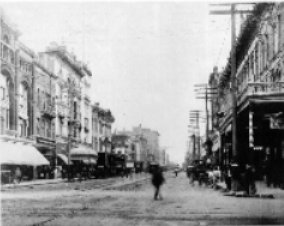
Main Street Houston (1930's)
The Big Ones Were The Great Depression
of the 1930's and WW II of the 1940's.

". . . families spent an hour or so on summer
nights parked in the entrance of a cemetery."
(We Weren't Cheap, We were broke)
During the 1930's it was tough enough trying to find money to pay the rent and buy groceries. There certainly wasn't much money left over for entertaining a whole family. That's how it became popular for families to spend an hour or so on summer evenings parked in the entrance of a cemetery.
The Forest Park Cemetery on Lawndale Street in Houston's east end was that place. There was a large pool with a fountain on the west side of the entrance with spaces to park in front of the pool. Actually the fountain was a number of different fountains in the pool that were choreographed to work together. The height of the streams and turning each spray head off and on for was controlled by a central control panel along with the lights.
The lights were what made the fountains so spectacular at night. There were different colored spotlights and floodlights in and around the pool that colored the water streams and sprays and changed colors as the water's spray patterns and highs changed every minute or two.
It was very dramatic to park and watch as beautifully colored jets of water shot up, some as high as 10 or 15 feet high and some only a foot or so, as they forming intricate patterns against the night sky.
It was a particularly good place for young courting couples to park. There were enough families parked in the area and enough light to where a young girl didn't have to worry to much about things getting out of hand. The main thing though was that it was free and money saved could be spent later at Princes Drive In for burgers and cokes.
I was with one of the family cars. I would sometime be invited to go with the Henry family from next door. Mr. and Mrs Henry along with their 3 girls and myself.
We were always looking for something to do that didn't take money. Like most young boys (around 10 or 12 or so) we wanted to want to build something with tools. Our little gang of friends, Billy, Pete, David, Buck and I decided to build a little club house to hold our secret meetings in.
Pete had a hard time getting permission to leave his yard sometime so we decided to build it beside his house. We scrounged the neighborhood for old pieces of lumber
We built a frame work about 6 feet square and 6 feet high out of assorted pieces of 2 by 4 and 2 by 6 lumber against the back of Mr. Otto's garage. The garage wall formed the back wall of the club house, saving boards and it leant stability to our building.
We enjoyed that project so much, that a few weeks later we decided to expand so we added a second story. By the time we finished the second floor, we realized that the club house, being about 50 or 60 feet back from the street was susceptible to attack from our enemies, since we couldn't see them coming. That problem was solved by building a platform up in the tree beside the club house, from where one of the club members could keep watch over the house.
That worked well except that we finally realized there was a blind spot across the rear of Pete's house. We solved that problem when we discovered a 20 foot length of 2 inch pipe. It fit exactly between our tree platform and a tree about 20 feet further toward the rear of the property. With an old piece of rope stretched between the trees, a few feet above the pipe to serve as a hand rail, we could scurry between the trees without coming down to the ground.
"Now we will be safe from a surprise attack by any enemies." We said, congratulating each other.
"Unless they come down the sidewalk in front of the house." Someone said.
Back to the drawing board we thought. There was one insurmountable problem however. There wasn't a board anywhere in the neighborhood that wasn't already nailed down. We finally solved the last problem by installing a tin can and string telephone from the tree platform to another tree at the front sidewalk. This security system may seem to be somewhat excessive, but it worked perfectly.
We were never attacked by an enemy (whoever they were) that whole summer.
Billy, who was the club's secretary, still has the original notebook with the club rules. Number 1. was, "Any one breaking wind inside the clubhouse gets two pokes on the arm from each member present.
III. The Big Football Game
"Hey Johnny, how would you like to go to the Rice football game this afternoon?" Mr. Henry called from his front porch next door.
"Sure," I answered, "let me go ask mom." Mom easily gave her permission. Mr and Mrs. Henry, with their daughters, lived in the other half of the duplex and were close friends of the family.
After we arrived at the Rice stadium and he had parked the car, I eagerly started toward the
ticket windows. Mr. Henry quickly called me back as he walked toward a little side gate. This was the old stadium, back in the forties when it was basically just some bleachers surrounded by a chain link fence.
When we arrived at the little gate Mr. Henry pulled out his fireman's badge and showed it to the gatekeeper.
In the nineteen forties, policemen and firemen could get into almost any public event by showing their badges. It was a small way that movies, stadiums and city busses had of helping the low paid public employees that protected their property and lives. The man at the gate let Mr. Henry through, but stopped me.
"Hey, wait a minute what about my kid?" Mr. Henry asked indignantly.
"He'll have to buy a ticket or get in another way. I can't let him in here." The gate keeper said as he turned and looked pointedly back down the fence line toward the end zone.
"Aw come on, firemen don't make that kinda money. Why don't you be a good guy and let the kid through?" Mr. Henry protested.
"Sorry bub, I don't make the rules, he'll just have get in some other way." The gate keeper answered before he turned to point his nose down the fence line again.
"Oh OK, I understand the problem." Mr. Henry said with a smile. My heart almost stopped when he started walking away, but he stopped about 3 or 4 yards down the fence and called me over. He told me to follow him and started walking down the fence line.
"OK," he said after we had walked down a little way, "climb over the fence."
"Oh no, I couldn't do that, I'll just wait in the car." I answered. Instead of being discouraged he beckoned to a couple of men walking toward the gates.
"Hey fellows, come here a minute," he said. "I'm a fireman and that so and so gate keeper wouldn't let the kid come in with me and he's scared to climb the fence." He added with a wink when they walked up.
The two men looked at each other and grinned. Then they grabbed me and pushed me up and half way over the fence and Mr. Henry pulled me the rest of the way over.
We sat on the ground along the sidelines near the end zone so we didn't see all of the action, but I enjoyed what we saw. I saw less then Mr. Henry did though because I kept looking over my shoulder for the huge policeman that I knew for sure would soon show up and to take me to jail.
Mr. Henry and dad both had a problem. Mr. Henry only had 3 daughters at the time and wanted a son. Dad had a son, but he had to work 3 to 11 PM and it was very seldom that we could ever got together. So, Mr. Henry would occasionally "borrow" me for father son type things. I guess now days it would be called male bonding?
IV. "Buff" Stadium
There was a lot of concern not long ago about Houston loosing one or more of professional sports teams and how much it would hurt the economy of city.
Hey, why worry, we survived loosing the "Buffs" They were Houston's professional baseball team before the Colt 45's. The Colt 45's? Yes, they were later renamed the Houston Astros. Of course we didn't actually do with out a team because the new ones took the place of the old ones before they were missed.
The old Houston Buff (Buffalo) Stadium was located at 4000 Harby at Milby. Don't try to find Harby Street, it lies peacefully under the Gulf Freeway. And, the Fingers Furniture store on the Gulf Freeway at Milby squats over the bones of "Buff Stadium".
Buff Stadium was more then just a ball park. One of my favorite memories is when our neighbor, Mr. Henry, took me with him to watch the "Hell Driver's" performance at the old Buff Stadium. We watched the daredevil drivers take their car's through all kinds of stunts. They drove around the field on two wheels and raced between and around each other all over the field, almost but never quite hitting each other. They jumped over each other's cars using a ramp to become airborne and another ramp to land on after soaring over a line of cars.
We didn't even have to worry about searching the stadium for good seats. We watched through holes in the big wooden wall in the outfield. Actually it was the scoreboard for the Buffs baseball games. After we climbed the fence, we stood on the score keepers catwalk and looked through the holes, where the numbers go to show the scores.
The Ringling Brothers and Barnum and Bailey Circus always set up their tents on the Buff Stadium parking lot. They would unload the train over on Navigation Blvd. and have a parade to the stadium. What I remember the most was the huge Mack trucks with what looked like giant bicycle chains driving the back wheels.
Every Fourth of July and New Years Eve there would be a gigantic fire works show in the Buff Stadium just after dark. We couldn't go because dad worked at night, but Mother and I would stand in the old claw foot bath tub looking out the bathroom window to see the beautiful sky rockets, roman candles and bombs of color bursting in the air above the Henry's garage.
V. Mr. Henry, The Surrogate Father
Mr. Henry served as a kind of surrogate father to me in many ways because there was a gap in that part of my life. My father and I got along well, but he was usually at work when I was at home and awake. It was that way until I was in my mid teens. But . . ., by then dad and I had missed our only chance to share my growing up.
It was during the depression and dad was a pharmacist until I was eight years old. I can hear your argument already, "But being a pharmacist is a good job and they make lots of money." During the depression, the typical pharmacist worked in a drugstore from 9:00 AM to 7:00 PM every other day and from 7:00 AM to 11:00 PM on the odd days. That was seven days a week. Every second week they were allowed to take a half day off.
If they lived close enough to the store to get home and back during their lunch period, they were allowed to go home for lunch and again for supper each day, but mom almost always took dad's meals to him at the store. At some stores he had to work from 7:00 AM to 11:00 PM every day, seven days a week.
Dad went to work for the Lubbock Drug store at Harrisburg and Sampson in 1933 when I was 5 years old. We always moved close enough to dad's job that he could walk to work. We moved into the duplex at 3008 Congress Ave. (Later changed to Garrow St.) because it was the closest place they could find to rent and it was only 6 blocks from the drug store.
Sometime I think that I knew my father better because of the visits mother and I made to the
drug store to take his supper then from the few times I saw him at home on his off time. At least it
was that way for my first 8 years. Then in 1936 dad went to work as a Houston police officer. He started as a beat cop walking Congress Avenue downtown (Skid row) from 11:00 PM to 7:00 AM, but he had a full day off every week. By the time he had finally worked his way to the day shift with weekends off, I was already in my teens.
Mr. Henry was a loving husband and father who had three daughters (when they moved in, and a fourth a few years later) who he loved dearly, but hidden somewhere in a place deep inside him, he was the type of man who needed a son to share with and teach. Now I'm not sure if we were just good friends or we were serving as a surrogate father and son team, but we both accepted our relationship for whatever it was and enjoyed the time we spent together.
The first time I saw Mr. Henry was in 1936 when he moved his wife and daughters into the other half of the duplex that we had lived in for the past three years. Since I was already eight years old by then and had seniority in the duplex, I supervised the moving in operation from their yard.
He was a City of Houston fireman and worked at the fire station up on Sampson Street at Preston. By then my dad was a City of Houston policeman so our families sort of meshed together from the beginning.
Mr. Henry was the person who helped me earn my first money. He drove me over to the junk yard after I collected some scrap iron to sell. He also gave me about half of the scrap iron that I had collected.
It was with him that I saw my first and only bullfrog farm. He bought a bunch of bullfrogs so his family could have a mess of frog legs. They even invited me to eat with then which was unusual as money was scarce for most families back then. Good manners would have made me refuse, even if I hadn't seen those legs trying to jump out of the skillet.
One of our first outings was when he took with him to watch the "Hell Driver's" performance at the old Houston Buffalo Stadium (now Fingers Furniture store on the Gulf Freeway). We watched the daredevils take their car's through all kinds of stunts. They drove around the field on two wheels and raced between and around each other all over the field, almost but never quite hitting each other. They jumped over each others cars using ramps to become airborne and to land on.
We didn't even have to worry about searching the stadium for good seats. We watched through holes in the big wooden wall in the outfield. Actually it was the scoreboard for the Buffs baseball games. After we climbed the fence, we stood on the score keepers catwalk and looked through the holes, where the numbers go to show the scores.
You have to understand though, Mr. Henry wasn't a tightwad. There just wasn't any extra money available for a public employee with 4 children to spend on amusements in the nineteen thirties and forties. He just enjoyed what he could from life and he wanted to share the parts that he enjoyed.
Even getting topsoil and leaf mold for both his and my mother's flower pots was an adventure. He would put a couple of wash tubs and a shovel in the trunk of his car. Then he and I would drive way out on Lockwood Drive to the deep woods beside Buffalo Bayou. We would fill up one tub and carry it back to the car, then fill up the other one. There wasn't any hurry and he accepted my help, clumsy as it was, as if I was an equal.
The grandest adventure I can remember for a teenage boy was the "Midnight Show" he took me to. That really proved I was just about an equal. In those days some movie theaters
herded everyone out on the street after the last show ended just before midnight on Saturday nights. Then they sold special tickets for a different movie that started at midnight.
That special night at the Old Texan theater up on Capitol Avenue was one of the few adventures we had that actually cost money. Come to think of it . . ., that son of a gun probably got in on his badge that night too.
I don't remember what the movie was. In fact, I probably didn't even remember what
the movie was when we got home in the wee hours of the morning. At the Texan, the stage show after the movie was included in the price. The comedian was funny and we laughed at his off-color jokes. The dancers and the music were good, at least in my eyes. But . . . it was the headline act that left me breathless.
First she took her gloves off while she was dancing Then somehow her blouse accidentally came off while she was twisting and dancing. Then when she loosened her skirt and danced out of it. By then I was pretty sure that it wasn't an accident. I watched in amazement as she continued to dance and her bra then later her panties fell away and she wiggled in front of us in all her glory . . . along with two pasties and a gee string. Wow! Women really were different from boys.
If the above memory causes a bad perception of Mr. Henry, it should quickly be made clear that Mr. Henry was also the man who took me to church and Sunday school along with his family every Sunday morning and again every Sunday and Wednesday night that he was off work. In those days firemen worked from 8 hour shifts one week and 16 hour shifts the next week.
By the time my dad had finaly worked his way up the ladder to where he was finally able to be off in the evenings and on Sundays, World War II had started. Between working overtime because of the manpower shortage and teaching night classes in Criminology at the University of Houston and me working after school, we saw even less of each other. I loved dad. He was always good to
me and I enjoyed being with him when we happened to be at home at the same time, but it was so seldom.
Now I realize I had a lot of affection for Mr. Henry too and I have to give him a part of the
credit for helping a young boy safely grow up to be an old man. Now I realize that I must have filled some small need that a man with 4 daughters may have felt for a son and made his life a little fuller at the same time.
VI. Neighborhood Business Men
There was only one place of business actually located within the neighborhood in the 1930's, Nagel's Grocery on Paige street near Harrisburg. In the early 1940's Nagel's closed and Mr. Parasco built a building in his backyard a half block north of Nagel's old store also facing on Paige street where Mr. Parasco opened a new grocery store.
Then the neighborhood was beset by an assortment of independent business men almost every day of the week. One, who we saw 6 days a week, was the vegetable man. His wagon's approach was announced to the housewives along the route with it's loud bell. mom always like to do business with our vegetable man. He only sold quality goods and he was a very interesting person who had immigrated from Syria many years earlier. In the U.S. he was an independent business man selling fresh vegetables and fruit from his rubber tired wagon. The wagon was pulled by a placid old horse who knew the route as well as his owner. Life must have been rewarding for the Syrian. He was very proud to be an American who owned his own business, but he especially beamed with the inner pride that he was sending every one of his children to college.
Then there was that group of independent business men who announced their wares with a familiar cry that every kid could hear from blocks away. That gave them time to try and beg a nickel from their mom before he arrived. "ICEEE CREAMMMM... ICEE CREAMMM," came their cry. A few of these men who were desperate for money walked the streets and sold popsicles and fudgesicles from an insulated wooden box about the size of a suitcase. It was carried under one arm with the aid of a leather strap over the shoulder. A couple of pieces of dry ice kept the ice cream from melting. Most of the regular employees for the ice cream sales companies, rode a three wheeled bicycle with a large insulated ice box between the two front wheels. A few, the elite, had the insulated box mounted between two wheels serving as the front end of a Cushman motor scooter.
The milk man stopped his truck at each house on his route book and carried quart bottles of milk and chocolate milk in his metal carrier to your door. If you knew him well enough and had a standing order, he may even come in the back door and put it in the ice box for you. If you weren't at home when he stopped, no problem, you just left a note stuck in one of the empty milk bottles on the steps and he would leave your order on the back porch. The milkman also sold whipping cream, butter and cheese. Some sold eggs and even ice cream
Up until the mid nineteen forties, the ice man's truck was a common sight in the neighborhood. The iceman would usually chip ten to fifty pound blocks from one of the three hundred pound blocks hidden under the heavy tarpaulin covering the bed of his truck. He either brought your standing order or you placed a cardboard sign in the window that showed how much you wanted Then he would pick up the block with his metal hooks, carry it into the house and put it in the icebox. The neighborhood youngsters always followed the ice truck to beg ice chips to suck on.
The Jewel Tea man with his panel truck full of spices, extracts teas, pudding mixes and other foods and condiments stopped less often but just as regular. Each time your purchases to date totaled a certain amount from him you received a free dish or bowl as a premium. Now those same dishes run from about 10.00 to 25.00 or 30.00 dollars per piece in an antique store.
Other small business men came regularly but much less often. There was the knife and scissors grinder who usually pushed his foot operated grinder with him like a wheelbarrow and worked on your front porch or sidewalk.
The sewing machine man only carried a small tool kit as he walked from house to house. He cleaned, adjusted and oiled your sewing machine in your home while you watched.
There was also the Watkins man who sold salves, pain killers, ointments, spices and medicines door to door from his truck.
Last but not least were the kids who fell for the advertisements on the back of comic books about making BIG money by selling Cloverine salve, a free picture with every box of salve, and all occasion greeting cards to friends and neighbors. Sometime they were the same ones who at other times tried to sell you newspaper and magazine subscriptions.
VII. Mind Graphics
Reading was a very popular pastime in the 1930's and 1940's. Even the corner drugstore was a lending library. Almost every drugstore in Houston had a bookcase about 2 foot wide and 5 or 6 foot high, filled with hardback books. The books could be checked out and read for a week for only 10 cents.
There was always a magazine rack, usually next to the bookcase. Most magazines were 10 or 15 cents. 25 cents was a high price to pay. Just about the only magazine I ever saw around the house was the Saturday Evening Post. It was delivered every week and was filled with short stories, jokes and cartoons. I grew up with Norman Rockwell's famous magazine covers and stories about Tugboat Annie, the female tugboat captain and Alexander Botts the tractor salesman. Dad subscribed to the Post from as far back as I can remember until they finally shut it down. I know, you still see it on the news stands, but that's a monthly watered down revival of the old Saturday Evening Post, with a few stories and many ads selling herbal medicines.
Paperback books were first introduced in England in 1936 and quickly caught on in the United States soon after. Comic books were 10 cents except for Classic Comics which were 15 cents. Once in a while a funny book (as we called them) publisher would put out a special that had more pages for 15 cents, or a really thick one for a quarter.
Another inexpensive way of reading were the magazine called "pulps". They were fiction magazines, printed on pulpwood paper, and sold only on newsstands, they featured stories of adventure and romance. The standard pulp magazine was about 128 untrimmed pages (7 by 10 in) and had a multicolored, glossy cover with a sensational illustration. They were about 90,000 words long and usually divided into about 6 short stories and one or two longer pieces--short novels or novels in serial form. Some of them also included letters to the editor, puzzles, and advertisements. The prices ran roughly between10 and 25 cents each. The first pulp magazine was Argosy, which begun as an adventure-fiction anthology by Frank Munsey in 1896.
By the mid-1930s scores of pulp magazines were available every month. In the late 1930s, however, superhero comic books began to compete with them. After World War II, television and paperback books provided to much competition and they slowly disappeared
Love stories were popular among women readers, but most pulps were written for a male audience and emphasized adventure. Westerns were the most popular; other types included detective, masked avenger, war, sports, and fantasy stories.
Some of my earliest memories are of me sitting in the closet doorway, leaning back against the door jam with my fairytale book and a couple of Little Big books in my lap. Sitting in the closet doorway, because the closet was where my toy box was kept. It was just a cardboard grocery box, but it held all of my treasures. Sitting there in the doorway, I could see Jack climbing the bean stalk. I could see the wolf blowing and the pig's straw house coming apart.
One of the grandest things that happened for me was when the bookmobile started stopping at the old Lubbock Elementary School every other week. Then later during summer vacation it began stopping at the Settegast Park. I read every Dr. Doolittle book the downtown library owned.
I read most of Mark Twain's stories such as The Celebrated Jumping Frog of Calaveras County, Tom Sawyer, Huckleberry Finn, The Innocents Abroad, and A Connecticut Yankee in King Arthur's Court.
Booth Tarkington's Penrod and his Seventeen were also delights for a young reader.
Jules Verne was the one though who really lit my reading lamp though with Twenty Thousand Leagues Under the Sea and the Journey to the Center of the Earth, Jules was the one who set the path for my favored reading for the next 60 some years. Around the World in Eighty Days was a good book, but it was possible back then.
I invented the term "Mind Graphics", at least I think I did. It's the term I use to describe the pictures you see in your mind. My generation was good at it, but I am afraid that most modern children won't have the opportunity to develop the skill. In my generation, we listened to stories on the radio and saw the pictures in our mind. Today's children hear and see entire story on television. No need for an imagination. In my generation, we read stories from hardback books and saw the pictures in our mind. Today's generation reads books that are profusely illustrated. No need for an imagination.
Mind Graphics probably started when our ancestors were living in the caves. When the hunters wove the tales of the kills around the campfire, each listener saw the hunter and the animal in their own way in their minds. Then bards and story tellers of the middle ages continued weaving pictures in the flames of the fireplace or behind closed eyelids as they told their stories. Later as printing became cheap and more people learned to read, books took the place of story tellers and later radio added even more to the imagination.
When I read Huckleberry Finn, I could see the raft floating down the Mississippi River with Tom, Huck and Jim on one end with the king and the professor on the other end. I could see Edgar Rice Burroughs' Tarzan swinging through the jungle on long vines.

T h e C o n t e n t s

I. We Weren't Cheap, We were broke.
There was enough variation in the patterns of light along with the different heights and textures of the spray that it was almost impossible to tell when the pattern begin to repeat it self. That made it possible to watch for a longer period of time without becoming bored.II. The Clubhouse
and our dad's coffee can collection of used screws, bolts, nuts and bent nails. People didn't throw those kinds of things away back then, not even bent nails, because they could be straightened and used again.