
To Old Houston, Texas
Back When When I was a kid.
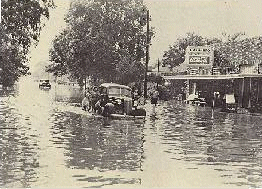
The Big Flood of 1935
The Big Ones Were The Great Depression
of the 1930's and WW II of the 1940's.

"The Good Ol' Days"
"Sure it was just a neighborhood
park, but to us, we were on the stage
at the City Auditorium in front of
hundreds of people."
("Me and Martha, Ellen In Show Business")
I don't guess there is a real boy anywhere that hasn't thrown a mud ball at somebody or at least at something. Now I don't know about girls, except that they hate dirt so I guess that excludes them from any mud ball throwing. Still, to the best of my knowledge, Billy was the only one of us boys who lived around old Settegast Park that ever got a whipping for throwing one. Not just a plain ol' whipping, but a whipping on Christmas Day.
Back in the early 1940's Pete and Billy and I were just standing around Billy's front yard talking about Christmas when one of us picked up a crawfish tower and made a couple of mud balls and threw them at the utility pole on the corner. Well of course the other two of us followed suit.
Now here's a quick explanation for those of you who don't know what a crawfish tower is. Crawfish, Crawdads or Mudbugs are miniature lobsters that live in wet ground or shallow flooded areas. It had came a pretty good rain just before Christmas and the yard was well saturated with water. When this happens, Mother Nature tells the crawfish to dig their holes deeper. Now as they dig they make little balls of mud about a half inch across and stack them around the entrance to their hole in the ground. The more they dig the higher the tower of small mud balls grows. They look like a stone tower at the corner of the castle wall. That day they were all over Billy's front yard, 3 or 4 feet apart and 8 or 9 inches high.
After a few minutes one of us picked up a stick about 2 feet long and stuck a mud ball on the end of the stick. Holding the other end of the stick and giving it a quick flip of the arm and wrist really sent the mud ball flying. Of course the other two of us quickly found a stick and we were flipping mud balls over the light wires and way over into the park. It was a contest to see who could flip a mud ball the highest or the furthest.
Then Billy came up with the idea he could beat us all and flip one all the way over his house from front to back. Go ahead we said, lets see if you can. Billy stuck a mud ball on his stick and with a mighty heave it went sailing over his roof. Just about that time, someone must have dropped a milk bottle or something because we heard glass breaking. For some reason we lost interest and tossed our sticks away and started talking again.
A few minutes passed before Billy's dad came to the front door and called Billy.
"Come here. Have you been throwing mud balls?" He ask.
"Yes sir." Billy answered. That was when his dad took his belt off and Billy got a
whipping on Christmas Day.
Later we found out that the mud ball really had went over Billy's house. In fact it went through the window screen, the window glass and the window shade in the bedroom window of the house behind his. And, to add insult to injury it landed in the middle of the bed, on top of a new white chenille bedspread.
Poor old Billy had a lot of bad luck like that. Take for instance the little clubhouse we built against the garage, in his back yard. We had gathered a bunch of long dry reeds down by the railroad tracks and wove them into walls. It must have been about 5 or 6 feet square and about the same in height. The weather was cold and the ground was pretty damp to sit on for a floor. We went down to the lumber yard in the next block and got a couple of tubs full of wood shavings to spread out and use for a dry floor.
Our little clubhouse hadn't been there very long when the people moved out of the old spooky two story house across the street. While we were exploring the house, we found a dozen or so number 2 cans of some kind of tar in the attic. Of course in the attic, we were boys.
Well it wasn't exactly real tar because it stayed liquid, but it was pretty close. We discovered it would burn pretty good so we took the cans back to our clubhouse and decided we could burn them for light since we didn't have a window. And of course, for heat since a house of woven reeds was pretty drafty. I'll never know why we didn't spill some in the wood chips and burn the whole thing down, along with the garage and board fence that made up two walls I guess we were just lucky.
Well, everybody except Billy. Somehow he got some of the tar on his brand new khaki pants. It wasn't a Christmas whipping, but he got one. Even worse his mama made us tear the clubhouse down for having a fire in it.
In the "Good Old Days" it was spare the rod and spoil the child. Of course I was always good and didn't need a whipping. But, mama did let this little ol' willow switch grow up in the back yard until it was a giant tree just so she would have a ready supply of switches. Now I am 71 years old, but I still remember how much a willow switch can sting your legs and change your attitude.
OK, all you girls, I have a question. Did you ever stuff your dress tail up and under your panty legs. No this isn't an erotic question. Girls used to do that when I was a kid back in the 1930's and they wanted to do something that might show more then a bare leg. The visual effect was that of a girl wearing a gym suit with elasticized legs.
You already know that my father was a policeman. Mr. Henry, who lived in the other half of our duplex was a fireman, so both families always went to the Policeman's Variety show and the Fireman's Variety show in the old City Auditorium each year. Both shows almost always had a man and woman acrobatic team that performed all kind of acrobatic stunts on the stage.
Martha Ellen (One of the Henry's daughters that I planned on marrying someday) and I would study each stunt with fascinated concentration. The next evening after supper, we would meet in our front yard, with parents on the porches of course. Martha Ellen would stuff her dress tail up and under her panty legs and we would learn, by doing, some of the acrobatic stunts we had seen on the stage the night before. Martha Ellen had a very good sense of balance and I was pretty fair at tumbling.
I would dive head first over her, on her hands and knees, do a quick roll and end standing up. Then she would do the same. We did some great cartwheels and then I would lay on my back with my knees up. Martha Ellen would take a few running steps and dive toward me catching my knees with her hands as her feet came up and over and I would catch her shoulders with my hands and flip her on over. Of course she landed on her feet standing straight up. I would get on my hands and knees and Martha Ellen would run toward my head, make a high dive catching my shoulders with her hands, duck her head and roll across my back landing on her feet next to mine
Another was where I would kneel down and she would step up on my knee, then up on my shoulder where holding my hand she would turn around facing the same direction as me. I would stand up, let go her hands to hold her ankles and then I would prance around the yard with her standing balanced on my shoulders. I know that little act doesn't sound very extraordinary now, but to a couple of kids in their early teens we were a great act.
One year the park director at Settegast Park gave a talent show and talked Martha Ellen and I into performing our act. The director got me a bright red satin shirt with puffed sleeves and she got a pretty acrobatic costume, with panties that were OK to look at, for Martha Ellen. Sure it was just a neighborhood park, but to us, we were on the stage at the City Auditorium in front of hundreds of people.
IV. An Unauthorized Visit The San Jacinto Monument
I guess Buck and I were a couple of the more adventurous boys around Settegast Park. We were about 14 or 15 years old that summer morning when we were sitting around, wishing we had something to do. Buck said, "We ought to go down to the San Jacinto Monument." The San Jacinto Monument was only about18 miles from Settegast Park.
My mom and dad were on a trip to California and my grandmother was staying with me. So I said "Let's go."
We both went home and fixed a couple of sandwiches and I picked up an extra inner tube for a bicycle and a tire pump. Buck brought a couple of wrenches and we mounted our bicycles and rode off into the distance. Well, actually we rode out Harrisburg Boulevard to the La Porte Highway then on east to the monument road.
Once there, we rode around the battlefield, stopping along the way, to read the signs. After the battlefield tour we locked the bikes and walked through the museum in the base of the monument. Like everyone else we rode the elevator to the top where you could look out for miles in all directions.
It was still early afternoon when we ate our lunch and started back toward Houston. By the time we were approaching Pasadena, we pedaling about 10 miles an hour and were pretty well give out. Our luck held though and we were passed by an old car going real slow and pulling a trailer. We speeded up enough to catch up with him and we each grabbed a back corner of the trailer. After we rested up for a few minutes, Buck rode up to the car and talked to the man for a while. The driver was only doing 15 miles an hour, because his car wasn't running well and his tires were bad. Hey, this during WW II and tires were almost impossible to find.
After we got home my grandmother ask where I had been and I said, "Buck and I were riding our bicycles."
"That's nice." She said.
I don't think I ever told my grandmother about our trip, but I did tell my mother. . . a year or two before she died and I had already turned 65.
Now, for those few who always look for the little inaccuracies in a story or TV program and are saying, "Ha ha, he didn't mention the Battleship Texas." That's because it wasn't there, it was still fighting in the Pacific during WW II..
V. My 1933 Ford V8???
I must have been about 16 or 17 when I started learning to work on cars. Mom and dad had and old 1933 Ford V8 Tudor that hadn't been ran in a few years and dad was positive that it was stone cold dead, never to be revived.
Being a teen, I was optimistic and just knew that I could get it going again. Of course the battery was long dead and wouldn't take a charge. I wasn't going to let a dead battery stop me, so I saved enough money to buy a new one. After I rode the bus to downtown, I walked over to Western Auto and bought a new battery. After I rode the bus back home, I installed the battery and run it down completely trying to start the car.
I don't know exactly why, but for some reason I knew that the carburetor must be bad. Back at Western Auto after saving more money, I was told that they didn't make carburetors that would work on the 1933 ford anymore. But, he said, if I changed the intake manifold to one from a latter model I could use a different carburetor on it and it would work even better.
For those of us who aren't mechanically minded the 1933 Ford used a single barrel carburetor. The air comes down through one opening at the top, mixes with the gasoline and exits through the bottom into the single hole in the intake manifold which divides the mixture into the 8 different passages to distribute the explosive air/fuel mixture to each cylinder. But it didn't exactly deliver an equal amount to each cylinder. So in the 1934 model, Ford used a 2 barrel carburetor, so that each barrel only had to divide it's charge of gasses to 4 different cylinders. The intake manifold had 2 holes on top to match those of the carburetor.
Sorry about the Hugh Downs explanation. Jack Parr once said, if you ask Hugh Downs what time it is, he tells you how to build a watch.
After saving some more money, I went to a auto junk yard and bought a used 1934 intake manifold and a rebuilt 1934 carburetor. I installed them and hooked up all the little rods and took the battery to be charged again. Needless to say, the battery run down before even kicked a single time.
Oh yes, I almost forgot, dad who didn't know one part from another, was constantly telling me that I was wasting my money. The old car was just junk, dead and could never be revived. This of course just made the car even more mine and made me eager to prove myself.
I finally begged and whined enough that dad finally agreed to push me around the park one time with his city car and that would be the end of it (the park was a block wide and three short blocks long). We pushed it back into the street by hand. I got in, turned the switch on and put the car in second gear while dad got behind me with his car. He begin push me slowly with his window open so he could shout instructions as he pushed. We made the block and a half to the end of the park and I made the left turn ok. Then we got to the next corner and I made that turn OK also. The motor was turning but hadn't fired a single time. My spirits were dragging until we got about half way down the length of the park.
Then it happened, with a roar the engine started and the old ford accelerated to about 20 miles per hour. Now 20 MPH does not sound like much, but to a teen who never drove a car before, it was breathtaking. I could hear dad hollering to slow down and I was standing on the brake when I turned the corner. Dad was still hollering for me to slow down when I turned the last corner and I made it standing on the brake again.
This was my first time behind a steering wheel and I had the bit in my mouth, so to speak and I wasn't about to stop until I got in my own driveway. I got it slowed down enough to make it into our driveway. I got it shifted into neutral and sat there with the engine racing until dad came up and started hollering at me about going so fast and to get my foot off the gas pedal. I finally convinced Dad that I wasn't racing and my foot had never been on the gas pedal. He was convinced when he saw my foot was off and the engine was still racing. Then I turned the key off and the wonderful sound of the engine disappeared.
I discovered later that the carburetor on the 1934 Ford sat about a half inch further to the front then in the 1933 model. This meant that the little rods I hooked up were a little short and held the throttle open enough that the engine couldn't idle and in second gear the car was running about 20 MPH. Well, I fixed that and I could start the car anytime and sit and listen to that old motor purr anytime I wanted to. Of course I couldn't drive it because I didn't have a drivers license and as I have mentioned in the past, dad was a Houston Policeman. Still, I was a teen with a car that I could drive someday.
Not long after that we moved to Eppes Street just off Telephone Road and the old Ford sat on the side of the street in front of the house where I could start it every once in a while and listen to it purr.
One day, a few months after we moved, I came home from school and my car was gone. When I ask mom what happened to my car, she said a lady down the street wanted to buy it, so dad sold it to her.
Dad, if you can read this over my shoulder from up there, you never did pay me for my labor and for what I was out for parts. Well, maybe you did in a lot of other ways.
VI. The 1936 Plymouth Coupe
My grandpa Daut died in Montgomery, Texas February 1, 1948. Later that year, grandma told me she wanted me to have grandpa's car. It was a 12 year old 1936 Plymouth Coupe. It was the same car that grandpa had let me drive about 3 blocks in low gear to the house in Montgomery. He wanted me to stay in low gear so in case I hit anything it couldn't do much damage. So much for confidence.
Any how, I still hadn't learned to drive well enough to go to Montgomery and pick up the car so I called my buddy, Pete. Pete agreed to go to Montgomery with me and drive the car back to Houston.
The first thing we had to do, of course, was to pull the battery and carry it to the filling station to leave it on the charger over night. Carry is the correct term because we had went up on the bus and didn't have any transportation, but it was only about 4 blocks. The next morning, we carried the battery back to grandma's house and worked with the car until it started. After saying our good-byes, we headed the old car toward Houston. We had already decided to return using highway 249, down through Tomball to avoid the traffic going across FM 105 to Conroe and down Hwy. 75 to Houston (this was long before Interstate 45).
I don't remember dad's exact words when he first saw the old Plymouth parked in front of the house on Eppes Street. But I think it was something like "Oh my God!!!" or maybe a little worse. I guess his first thought was that I didn't have a drivers license or enough driving experience to mention and the fact that he was a police official with HPD and didn't need an incident with his son. Of course, I was rejoicing on the inside and thinking, OK old man, now we're even for you selling my first car.
Mom often went shopping in the afternoon and dad was still at work when I got home from school so I drove the old Plymouth around the streets of the Golfcrest Subdivision and sometimes even for a few blocks on Telephone Road. After mastering the mysteries of the clutch and shift lever sticking up out of the floorboard, I became a fairly good self taught driver.
The problems started when I went downtown to the County Courthouse to renew the license plates. Are you Henry Albert Daut, the lady ask. No I'm his grandson. Where is he? He died. Sorry, no license until the title is changed over to the new owner. Grandma and I finally got the title changed (no help from dad) and I was able to buy the new license plates.
Pete and I hadn't really paid a lot of attention to the soft muffled knocking sound coming from under the hood on our journey home from Montgomery, but now it seemed to be somewhat louder. Nellie and I got married about this time and Pete and I brought the old car to the new apartment and Pete decided that the rod knock needed attention, before I started driving it regularly. We jacked the car up and dropped the oil pan and I bought a new set of oversized rod bearings to take up the slack and stop the knocking. If I remember correctly, it was about 3 or 4 weeks before the knocking sound came back. Back to the parts counter for another set of rod bearings a size thicker. After we installed them and drove for a few weeks the knocking sound became audible again. Oh, didn't you know, the parts man ask, that model has a hollow crankshaft and after it gets older it develops a flat place on the bearing surface. The only thing you can do is replace the crankshaft.
Then there was the night we drove it down to the Irvington Drive In Theater. I remember when I parked beside the speaker post the car rolled back a foot or two while in gear, but we could see OK so I didn't worry about it. After the movies (double feature) were over I stepped on the starter and nothing happened. The engine wouldn't turn over. Some kind soul tried pushing us to get it started, but the back tires just skidded and wouldn't turn. We left the car and walked the few blocks back home. Pete pulled the car home the next day. Acting on a hunch I pulled the sparkplugs and stepped on the starter. The motor spun and water shot out of one of the holes. It had dawned on me that the head gasket leaked a little and when the car rolled back the piston went down, sucking water through the leaky gasket and filled the cylinder with water. If you remember your Physics 101, liquids cannot be compressed, so it wasn't much different then if someone had put a hunk of iron on top of the piston and it couldn't rise again and the motor couldn't turn over
It didn't take long for Nellie and I to decide that riding on the city busses was a lot cheaper then the care and feeding of a 1936 Plymouth Coupe.
VII. When I Almost Died (and almost wanted to)
I was plowing furrows in my scalp the other morning with the comb and thinking that this was the second time in my life that my hair was thin enough that the comb slipped through without hindrance. The first time, I was only 17 instead of 71. It was a Monday morning and the first day of the last six weeks of the school year.
I woke up feeling lazy and just didn't want to go school. Mom believed me when I said I was sick and needed to stay home. It was a easy laid back day and I read books and listened to mom's soap operas on the radio until about 3:00 o'clock when my programs came on. You know, programs like Little Orphan Annie, Dick Tracy, Terry and the Pirates, Jack Armstrong and Sky King. I stayed in the house all day, I didn't figure I should stretch my luck by asking to go out and play ball or something.
The next morning I really felt rotten and was able to talk mom into letting me stay home again, but it was a little harder. The day passed about like the day before except I really didn't feel worth a darn. The next morning, mom woke me with the order to get out of bed and get ready to go to school, 2 days of laying around was enough. I felt like I might croak just about anytime and finally convinced mom that I was sick as a dog.
That was the beginning of five weeks of heck (This being a family web page, I can't use the word that means the nether regions where the fires burn eternally.) The doctor came to the house (They really did that back then) and declared that I had Yellow Jaundice. For all you younger folks, nowadays it's called Hepatitis.
If someone had hollered, don't shoot til you see the whites of his eyes, I would have been safe two feet from the shooter. The "whites" of my eyes was the color of butter and the color of my skin wasn't to far behind. The fever was very high for a few days and then stayed over 100 degrees for about three weeks. I threw up everything but pear nectar and now it makes me sick to even smell it.
My nose would start bleeding 2 or 3 times a day. Now to add insult to injury the doctor gave me a shot of Vitamin K. This is what we give women who have just had a baby to control their bleeding, he boasted to a teenage boy. My hair came out by the handful and I was weak as a pussy cat. I made it back to school the last week of the final six weeks to take finals.
VIII. Bicycles
Bicycles were the major mode of travel for teens living around Settegast Park in Houston during the 1930's and 1940's. We rode them for basic transportation to get somewhere without walking. We rode them just for the fun of riding. We raced each other. And, being boys and teens we even tried a little trick riding to show off sometime.
I was pretty good with bicycle tricks myself in the 1940's. First, I learned how to get up speed, then put my feet on the handle bar and guide with my feet until the bike slowed down and I had to pedal again. Then, I learned to ride without holding on to the handle bar at all. I could go for blocks , even turning corners with out touching the handle bar. If there were girls nearby, I would get up speed and while holding the handle bar I would stand up and put one foot on the seat and the other up in the air. Thinking about it now, I must have looked like a pointer dog sniffing a bird to the girls.
After a lot of practice I learned how to stand up and wedge one foot between the two cross bars between the seat and the fork. Next, I would put the other foot on the back fender, wedged behind the seat. Then I would let go the handle bar and stand upright, guiding by shifting my weight and changing the center of balance. Actually I got pretty good and decided that I could really impress the girls with that trick. There were about 4 or 5 girls in the Henry's front yard the day I decided to illustrate my expertise with a bike.
I started way down the block and built up speed until I was close to the girls. I set my feet and breezed by them standing on top of the bike for a few feet before I lost my balance and took a dive to the blacktop street. It wouldn't have been quite so bad if there hadn't been a fender bender a day or two before at that same spot that left many tiny pieces of glass on the street. You know, the old story about getting back on the horse after he throws you is true. I've never ridden a bike standing up on top since that day.
Regarding transportation, my mom wouldn't even listen to my pitiful pleas to ride my bike to Stonewall Jackson Junior High School. I tried everything, even how much money the family would save on bus fare. It cost four cents each time I rode the special school bus that the bus company ran each morning and afternoon. I tried to tell her it was only 2 miles, to no avail. I finally gave up and Billy and I made a very elaborate plan. That evening, I locked my bike in Billy's garage and walked home. I went around the back and locked the garage door before I came in.
"Did you lock your bike in the garage, Johnny?" Mom ask.
Yes mam, I sure did, I answered, not mentioning the fact that I had locked it in Billy's garage. The next morning I walked down to Billy's house like I always did, but this time we got our bikes out of his garage. We were free as we peddled along with the wind whipping our hair. When we got to school we parked our bikes in the racks with all the other free souls and went in to homeroom.
That was one of the most miserable days I remember. All day long I could envision some unscrupulous person stealing my bike from the rack and me trying to explain the loss of my bike to mom and dad. That was the only time I every used my bike for transportation to school.
IX. Old Mike, Every Boys Friend
Mike was the friend of all the boys around Settegast Park. He was black as the ace of spades, about 2 foot high and one of the most personable and understanding dogs I ever knew. There was no way to distinguish what breed he was. He was just a well formed dog, black, with a smooth short coat
I'm don't think he ever believed that someone owned him. He was a free spirit and would play with any of us as long as he wanted to play. But, when he got through playing he let you know as gentle as he knew.
I used to see him coming trotting down the street and I would holler, "Hey Mike." He would always turn and come over to visit for awhile. He loved for me to hand wrestle him when he came to visit. You know, I would rough up his back and neck and rub his head and ears. He liked it and would nibble at my hands to get even. Not bite, just mouth a little, but Mike's muzzle was turning a little gray and he tired after 5 minutes or so.
When he was through playing, he would grab my wrist with his mouth in a tight, but not painful grip and just hold it for a few minutes. After he let go and you tried to rough him a little he would quickly grab my wrist again and you knew he was through playing for awhile.
One thing Mike didn't like however, was other dogs that didn't acknowledge he was the top dog of the neighborhood. He had a very unusual way of fighting that didn't really hurt the other dog, but quickly let him know who was the boss. When he saw another dog who needed a lesson, even a block away, he would take off at a trot. He would pace his run so that by the time he reached the other dog he was running as fast as he could. The other dog would prepare himself for a fight with a mouth ready to slash and bite when Mike stopped in front of him. That didn't bother Mike a bit because he didn't like to slash and bite and didn't intend to. Mike had a much better plan. Still running at top speed, Mike would run head on into the other dog, knocking him rolling head over heels. When the dog stopped rolling Mike was there, standing over his adversary, growling with his mouth at the other dog's throat. He never had to bite. The other dog, knowing he could easily die any second, gave up at once and then Mike trotted off with his head held high.
There was only one dog in the neighborhood that I never saw old Mike mess with. Of course it was behind a fence most of the time, but I think Mike was to smart to try it with him. That dog was a large black chow. I never got close enough to check his temperament during the times he escaped the fenced yard. The first kid to see him out would holler "CHOW" and you wouldn't see a kid outside anywhere except the ones that were to far to make it home. They would all be in a tree somewhere. We were a neighborhood of trees and barefoot boys could climb trees almost as fast as squirrels with a little incentive.
You know, I've been thinking about this as I am writing. I stated above that, "He (Mike) loved for me to hand wrestle him when he came to visit." Now I wonder if he really loved it, or if he just put up with a kid's game for awhile to appease me since he was a guest.
X. The Big 1935 Flood In Houston
Mama and I were visiting my grandmother in Pine Island (about half way between Waller and Hempstead) for a few days when the rain started. After it had rained for a couple of days there was no sign of letup. After a couple of days of the rain, mama finally had enough and decided it was time for us to go home regardless. And when mama decided to go home, we went home. We climbed into our Tudor 1933 Ford V8 and headed toward Houston. All of the ditches were full and the fields were covered with water. However, the highway was clear and we made pretty good time until we got down around Cypress on the Hempstead highway.
Just past the Cypress community the water was flowing across the highway. Well, mama was on her way home and she wasn't going to let a little water stop her so we drove right on through the high water. We were still driving through water when we reached the end of Washington Avenue at Eureka (the railroad underpass is there now.) That was about 18 miles of water covered highway.
Mama wasn't too worried about driving through the water because she could see the tops of the fence posts and stayed in the middle between them. Besides, another car was following right behind us. It gave her a little confidence that the other car was on the exact same path we were. She figured the guy knew where he was going. Mama didn't even seem worried by the water swirling around our feet in the floor boards. Anyway, we made it through OK.
She did seem a little set back however, when the other car pulled up beside us at the first red light and the man told mama how much he appreciated her leading him through the water. He said he figured if she disappeared, he could stop in time.
That was the flood that caused the Army Corp of Engineers to build the Addicks Dam and the Barker Dam. They were built to slow future runoff water from the north and west sides of Houston. That area feeds it's waters into Buffalo Bayou.
Of course Buffalo Bayou's flooding had caused an enormous amount of damage in Houston. Soon after we got home several blocks on each side the bayou were flooded from one side of Houston to the other. Main Street was flooded for a couple of blocks on both sides of the bridge at the M and M building (Now the University of Houston Downtown) cutting of any connection between the north and south sides of Houston. The upper floors of the M and M building and the middle of the bridge were an island in the stream. The Milam Street bridge over the bayou was destroyed and not replaced for 20 or so years. Almost all of the buildings beside the bayou on the south bank lost their back walls, removed by the water and some of the buildings were completely destroyed. I am talking about 3 or 4 story brick buildings.
At that time, my uncle H.W. Phillips, was working at the Henke Ice Company on the north bank of the bayou at Milam. He and some of his coworkers lived on the second floor for a couple of days until the flood waters subsided but they didn't mind to much. The Sears and Roebuck warehouse and it's retail store was located upstream on the Allen Parkway (then called Buffalo Drive) at Taft Street, on the south side of the bayou. The flood waters washed through the store and warehouse taking everything that wasn't fastened down and a few things that were. The water was flowing so fast that the lighter things, mostly in wooden packing cases especially clothes and white goods didn't sink and floated right up on top. Uncle Wendel and his coworkers were lined up at the second floor windows of the Ice Company with long sticks and poles fishing out the boxes as they floated past the windows. Mama didn't have to buy me any overalls or BVD's for a year or so. They could have had enough cars and trucks to last a long time if they could have roped then and pulled them in as they floated by. Cars and trucks floated by like fishing corks in the rushing waters.
I mentioned the Milam Street bridge a few times and wanted to add a little sidelight. In later years when they finally started replacing the bridge, work was stalled for a short time while the workers carefully dug up the huge number of still active canon balls from the mud in the bottom of the bayou. It seems that the Confederate army had an armory in that area and when the invading yankee army took it over, they dumped the canon ball into the bayou and they had been there since the later part of 1865.
T h e C o n t e n t s
I. The Mudball Christmas
II. The Tar Baby
III. Me and Martha Ellen, In Show Business
The End