- Background
- Montgomery, Texas
- Kids Having Fun
- Movies In A Tiny Town???
- More Kids Having Fun
- Enemy Soldiers In Montgomery
- Boy Girl Stuff
- Comic Books???
- Earning A Little Money
- Return To Top
- Return To First Page

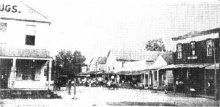
To Main Street In Downtown
MONTGOMERY,TEXAS
Circa 1920
More Of Growing Up
During The Big Ones
The Big Ones Were The
Great Depression of the 1930's
and WW II of the 1940's.
Contents
"Background"
My dad was born and raised in this tiny town where he graduated from Montgomery High School at the head of the senior class in 1922. Of course that meant that his best friend Gerald West had to graduate at the bottom of the class since those two boys made up the entire senior class.
I never really lived very long at a time in Montgomery, just a few weekends during the winters and a couple of months during each summer, but to me each time was like coming home again. Montgomery sits mostly on the north side of Texas 105 about 15 miles west of Conroe and straddles FM 149 north of Tomball.
I lived there as many weeks as I could each summer during the 1930's and 40's. My grandmother and I tried every year to get permission for me to stay with her and grandpa during the winter and go to school in Montgomery. The answer was always the same, "Get in the car, you're going home with us."
Those requests didn't have anything to do with mom and dad, it was just that I couldn't face the idea of having to come back to Houston. I hated the Houston schools. I would have quit in the sixth grade instead of the twelfth if I had thought I could have gotten away with it. Dad was a policeman and I was brainwashed about how kids who didn't go to school ended up in juvenile detention at the Gatesville Reform School. My grades reflected my hatred of school and my unconscious rebellion. While attending the old Sam Houston High School in downtown Houston, I remember meeting my English teacher (who shll remain nameless) in the hallway at the end of the semester.
"John," she said in a soft voice so no one else would hear, "I passed you this year, but please don't ever tell anyone who your English teacher was."
I find it strange now, how wisdom sometime comes with age. The college courses that I took after I reached my forties were actually enjoyable, (Including English Mrs. Hugg, you would be proud.) and I couldn't believe how easy it was to maintain a straight 4.0 grade point average.
Even though grandma and grandpa never owned a home there, they loved Montgomery and wouldn't consider living anywhere else. Their only roots there were in a rented house, friends and memories, but it was enough. Dad tried his best to convince them to move to Houston during W.W. II, but to no avail. At that time a skilled carpenter in Houston made twice as much money as grandpa charged for his work in Montgomery. Now they are both buried there, still in the town they loved..
"Montgomery, Texas"
When I was a boy in the nineteen thirties, there were three gas stations, the phone company, a feed store, a furniture store, a drug store, a doctor, a blacksmith, a carpenter, a paper hanger, four general stores and one plain old grocery store that was located in the old bank building.
When dad was a young boy in the nineteen teens there was an additional general store or two, the county courthouse, a bank, a hotel, two cotton gins, three doctors and five lawyers. Today, Montgomery's business district seems to consist of two gas stations (groceries in one), three cafes and twelve antique stores.
Life in a small southern town like Montgomery was still slow enough to enjoy when I was a youngster. Grandma walked to the post office (about 5 city blocks) almost every morning after we had breakfast and grandpa had left for work. Grandpa was the town's contractor, carpenter and general repair man and when there was a need for one, grandma was the paperhanger.
I can almost see grandma now, walking to town along highway 105, then still a gravel road, with her parasol held high to keep the sun at bay. She would often stop and visit for a few minutes with Pearl Saunders or one of her other friends who lived along the way.
While in town, she would usually stop to buy what ever she needed for that days dinner (the midday meal.) She usually shopped at either Jackson's downtown or Huff's store at the corner of highways 105 and 149. Most days she would also stop in Mildred Price's store. Mildred was the one who located in the old bank building after her first store burned down. Sometime grandma shopped at Berkley's or either John or Frank Powells, but not to often.
Dinner was the main meal of the day and grandpa always came home for dinner at noon if he was working within driving distance of home. Sometime he had jobs in Magnolia or Shiro or Richards and took a lunch. After they finished eating dinner, grandma would cover the table and food with another tablecloth and grandpa would go back to work. After he came home from work at 6:00 PM the upper tablecloth was removed from the table and supper would be ready.
Like young kids anywhere during the 1930's and 1940's, the ones who lived in a tiny town made their own fun. We fished in a couple of nearby stock tanks (small man made lakes) and swam in Town Creek. We went to church on Sundays, sometime to the movies during the week and even political speeches on Saturdays near the elections. We fought cowboy and indian wars during the day with rubber guns and read funny books and books about cowboys and indians after dark
My grandpa was a fanatic when it came to reading pulp western magazines. I can see him now, sitting in the porch swing, petting his huge tabby tom cat while reading his latest pulp western magazine.
Most of the boys would walk down to the depot and watched the night train come in and sometime during the day to talk to the German POWs.
Sometime one of the girls would talk her mother into having a party for kids. And like all the kids of the era, we read and swapped funny books, as we called comic books back then.
The small stock tank on some of T. J. Peels land by the cotton gin was a fisherman's dream when we first started fishing it. It hadn't been fished in years. Maybe they were scared of T.J., but I had enough sense to walk up to him and ask if I could fish in his pond.. Tootsie Sanders and I would dig worms until we were tired, then grab the poles and walk over to the tank. It's not a fish story to say the bluegills would actually fight for the worm as soon as they touched the water for the first two weeks. We soon learned that we could do just as good by catching a grasshopper and sticking it on the hook instead of digging. Once, I was to lazy to catch grasshoppers and peeled a wild grape to use as bait. It didn't work good, but it worked.
Swimming in Town Creek was strictly a boy thing. Come to think of it, I don't think we ever invited the girls. I guess we just assumed they would have frowned at swimming in the nude. Some of us boys, Leon Hill, Red Akins, Charley Harrison and Phil Ottis Berkley and I would walk back into the woods a ways to the swimming hole. We would start stripping before we got there and be stark naked when we arrived at the water's edge. Of course grandma was scared to death of water and I had to fib slightly about where I were going. Then I had to wait for my hair to dry before I could go back to the house.
Grandma was smarter then me though, and got Mrs. Berkley to keep one eye on the road in front of her house and tattle when she saw me go by. That ended the swimming in the creek. Later I also discovered that the man who owned the pasture had saw us swimming through the small whirlpool after a big rain and tattled big time.
We went to Sunday school every Sunday morning, some to the Methodist Church and some to the Baptist church. After Sunday school everyone usually went to the same church together for services. Neither church had enough parishioners to support a full time preacher so each church held church services every other week on alternate Sundays.
Actually, most of the boys weren't that religious, but it was a good time to be with the girls and if we didn't whisper and giggle to much we boys could all sit together in the back pew and watch everything without being watched. Prayer meetings on Wednesday nights were even better because they didn't seem as formal.
"Small Town Movies"
Movies, sure we had movies. Not all the time, but usually for a few weeks each summer. There were usually 3 or 4 traveling tent shows that came to town every summer. They would set up their big tent in the small field behind Huff's store or sometime on the vacant lot beside the bank building and stay for a week. Then they would put out a row of benches down each side of the tent with a tarp strung down the center of the wide middle isle. Then they would start popping popcorn and shaving ice for snow cones just before dark and be ready to show the movie when it got dark.
The tarp divided the tent in half so the white people could sit on one side and the black people could sit on the other side. Remember, this was a long time before integration and it was the traveling show owner's answer to taping a town for every dime he could and not because it was a burning social issue with him. Admission was only ten cents, but that was an hours pay for a lot of people during the depression.
Of course Mr. and Mrs. Huff always set up front like royalty without paying a cent. The free tickets was their payment for the use of their land and electricity for the movie. In all of those hours after dark, spent in a hot tent with my eyes glued to the screen, I don't believe I ever saw a single movie that wasn't a grade B western. But somehow I enjoyed it as much as going to the Metropolitan or Kirby theater on Main Street in downtown Houston.
There was one of these old traveling movie outfits that really stands out in my memory. The equipment was so old that they could only show silent movies. They showed up one day and set in the vacant lot next door to the bank building. Set up means they put out some old wooden benches and set up a couple of carnival games, like pitching pennies at little squares on a board and throwing some lightweight balls at weighted wooden bottles. They also had a hamburger stand. The stand and games were their only way of making money. Since they didn't have a tent, they couldn't charge admission. The ancient silent film hand cranked projector was so old it didn't use a projector bulb. It had a carbon arc lamp. An electric spark (like an electric welder) jumped across 2 pieces of carbon inside the projector causing a brilliant light. But, not counting the loud hissing noise and the smoke it worked
"More Fun For Kids"
Even political speeches on the couple of Saturdays before the elections were entertainment to us back then. There was no such thing as television of course and money for radio was hard to come by. The answer for politicians especially county and even state level was to visit every little town they could and made a speech from the back of a truck parked on the Main Street, pass out cards and shake every hand in sight. Then they would rush to the next little town.
I remember once when "Pappy" Lee O'Danials made a speech in Montgomery while running for State Governor. "Pappy" owned the Bewley's Best flour mill in Ft. Worth. His slogan was "Pass the biscuits Pappy." He had some ovens mounted on a trailer that went with him on the campaign trail. A couple of his employees baked biscuits in those ovens and passed them out to the crowd. while he made his speeches.
It was almost a contest among the boys to collect as many political cards as we could like kids collect baseball cards now. We got most of them from the ground when the grownups threw them away though, because most politicians didn't waste cards on non voting kids.
One of our favorite games was cowboys and indians or outlaws and sheriffs battles with rubber guns, a long barrel gun made of wood with a spring clothes pin mounted on the back of the handle to serve as the trigger. Large rubber bands, actually sections cut about � to � of an inch wide from an old auto innertube were the ammunition. You opened the clothes pin and caught one end of the rubber band. The other end was stretched over the top and hung on the end of the barrel. When you squeezed the handle (and clothes pin} the rubber band shot forward with fair accuracy and with enough force to sting a little at 20 feet or so. The hardest part was getting an old inner tube to make the rubber bands from. It was during World War II and new real rubber inner tubes were almost impossible to come by which meant that old ones were treasured and had many patches or rips and holes that couldn't be repaired before they were discarded.
There was an old barn in a small field on Church Street that we usually fought our battles in. It was divided into 5 or 6 sections with an upstairs and a lot of bales of hay that made an ideal battle ground for us.
I read many a story about cowboys and indians at night or on rainy days after I exhausted my throve of comic books. Grandpa was a fanatic about reading. He read almost anything, but it was usually dime pulp western magazines were very popular among some of the men in Montgomery. I guess his friends knew that he really couldn't afford to buy them and passed theirs on to him. Grandma only read the Bible and the Trail of The Lonesome Pine
One of the common sports among the boys was watching the train come in every night. The Montgomery depot was on the end of a little spur track off the main line and the train would pull in every morning on it's east bound trip, then back out to the main line and continue it's run. About 8 PM the train would return and back up to the depot from the main line. After doing it's business it would pull out forward back to the main line. So if you had business in Conroe and didn't have a car, you rode the train over there in the morning, spent the day, then rode the train back at night.
What made train watching so much fun at night was the fact that the engineer didn't turn his headlight on until he started to pull out from the depot. Once in a while, one or two of the more adventurous boys would slip out on the tracks in front of the engine and rub the rails good with soap for about 50 feet or so. After the train moved a few feet it hit the soaped area. The train would come to a complete stop, but the drive wheels would be spinning at about 50 miles an hour. Of course the friction would quickly burn the soap off and the train would barely creep along with the wheels still spinning at about 50 miles an hour for 50 feet or so.
"P.O.W.'s"
We were all very patriotic, but I guess teen age boys didn't feel the hatred for Germans that the adults did during the war. We used to walk down to the depot and talk to the German Prisoners Of War during the day. There was a POW camp at Huntsville and they brought about 10 POWs, guarded by a US Army sergeant to Montgomery each morning to load pulpwood onto railroad flatcars. All of those Germans were captured by the American forces in North Africa.
They each, including the sergeant had a sack lunch with a jar of tea. After lunch they, including the sergeant, would lay down on the depot platform and take a short nap. The sergeant would field strip his rifle to show us boys and the Germans how it looked and operated. Needless to say he didn't worry about his crew enough to keep a clip in his rifle. As the sergeant said, why worry, where would they go, there's a whole ocean between them and their home. After lunch and a short rest, the prisoners would get up, put the horse collar pads across their shoulders and carry the pulpwood logs to the flatcars until the truck arrived to take them back to the camp for the night.
A couple of the prisoners spoke fairly good English and showed us pictures of their families and talked about life in Germany before the war. That was the year we discovered that the average German soldier was a man who loved his family and country and had to obey orders just like everyone else.
Regarding the war itself, it was funny, but to a man they all still thought Hitler was a great man and would have been the savior of the German people. However, they hated the seconds in command under him such as Goring, Gerbels, Hess and Himmler and blamed them for the war and all of Germany's current troubles (1943 or 4)
"Boy Girl Stuff"
Sometime one of the girls, Katherine Weisinger, Johnny Beth Berkley, or one of the Powell girls would talk her mother into having a party for the young people. We would play games where the boys and girls would interact together under the seeming uninterested, but watchful eyes of the girls mothers.
I don't remember the game now, but in one party at Johnnie Beth Berkley's house a boy and girl had to walk around the house together (nighttime.) That was the night "I cut my foot" pretty bad. Being basically a city boy, I wasn't up on all of the country expressions. As we walked I accidentally stepped in a fresh pile of cow poop. Oh no, I stepped in a cow pile, I said. No don't say that, she giggled, you cut your foot. At least she waited while I wiped my shoe in the grass.
Another favorite pastime after we got a little older was for two or three boys and an equal number of girls to ride out to the old fire watch tower south of town at night and count stars.
"Comic Books?"
All kids loved to read funny books (comic books), but swapping them was an art that we all had to master or you ended up with a pile of scrap paper. First, you never accepted one with s torn or missing cover in an even swap for one in good shape. They were only traded for one in a similar condition or on a two for one basis.
Classic Comics were almost as bad for most traders. They were sometime hard to swap because they were just stories from, ugh, real books without pictures like Little Women or The Scarlet Letter. Personally, I was one of those kids who was cursed with the reading bug and enjoyed reading almost anything. I would even read the entire English literature book in the first few days of each new semester.
Everybody liked the comics with Batman, Superman, Captain Marvel, the Flash and the Human Torch. Disney comics was also very popular. John Smith, the school superintendents son was the only kid I ever knew who subscribed to a funny book. He got a brand new Walt Disney funny book in the mail every month.
Most boys weren't to happy with Wonder Woman comics, but we read them and were amazed at how she could catch bullets on her bracelets and lasso spies and crooks and they would have to tell the truth.
The drug store in Montgomery (and other small towns) would tear off the front covers of all the unsold old issues of comic books when they were replaced on the racks with new ones. The fronts were then returned to the distributor for credit. The lady who worked in the drug store would give the cover-less books to certain kids in town. Of course that was kind of hush hush and now I realize it was to the kids who couldn't afford to buy the new ones. I guess I must have been poorer then I thought in those days because I got a free one every once in a while myself.
I haven't mentioned listening to the radio, because we didn't. Grandpa had one, but it was only allowed to be turned on every day at noon and six o'clock to listen to the news..
"Making Spending Money"
Sometime there was a little extra money for a teen age boy to earn. One summer I worked for the Montgomery telephone company. At the time they still had crank phones and cedar poles for some of the phone lines, particularly the line to the Cartwright home and their mill at Keenan where they made stone ground corn meal. I remember those poles well, six to eight inches across and sixteen feet high.. Try climbing one of those with a pair of climbing hooks. Besides the loose cedar bark, you had to be extra careful not to miss the little pole and stab your other leg.
Another way of earning extra spending money used by adults and teens alike was picking the wild Blue Bell flowers. Florists from Houston would drive to Montgomery during the season and buy the wild blue bell flowers.
The End

Corky's Custom Pages
And Welcome Created