
To The Ol' Sam Houston High School
The Last Part Of Growing
Up During The Big Ones
The Big Ones Were The Great Depression of the 1930's and WW II of the 1940's.
An autobiographical journey through High School
in the 1940's.

"DEPRIVED 'WUZ' US"
"Members of the team had to walk 17 blocks, over to the city's old Westend Ball Park to get to football practice. But of course, we got out of going to the 6 th. period P.E. class. . ."
Sam Houston is a name recognized by almost every Texan. Even most of the emigrants from foreign lands, such as Michigan or Illinois, are familiar with that name. The name is almost magical, in that it can stimulate a different image to different individuals.
Sam Houston State University in Huntsville would leap into my oldest daughter's thoughts. One daughter-in-law would automatically remember that massive brick main building and the permanent, wooden frame temporary buildings of the current Sam Houston High School on Houston's north side.
The other daughter-in-law would probably summon up the picture from the Texas history books; a victorious General Sam Houston sitting under a tree nursing his ankle
wound after the battle of San Jacinto while the younger daughter may think of the first president of the Republic of Texas Then there is that select group consisting of a few thousand Houstonions who will always think of those days when we attended the "Old Sam Houston High School". That's the one that was in downtown Houston, during the nineteen thirties, forties and fifties. Webster's dictionary defines "Deprive" as,
1. To take something away from. I don't want to sound like a cry baby and of course by now it's ancient history, but if all the ex-students of old Sam Houston High School got together, we could form the local chapter of "Deprived 'Wuz' Us."
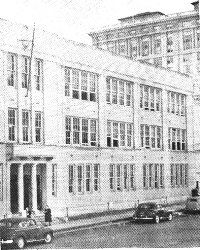
Old Sam Houston High was a light colored three story brick building. It was horseshoe shaped and covered most of the city block behind the old main post office (now the U.S. Customs building) in downtown Houston. The old school extended right up to the sidewalk on three sides. It fronted on Capitol Avenue with Caroline and Austin streets on each side and the open back side of the horse shoe faced Rusk Avenue.
Old Sam Houston was built, almost on the ashes of Central High, as a replacement for
Central after it was destroyed by fire. Central High was the Houston high school where a young Lyndon Johnson taught before he entered politics.
Old Sam Houston was one of, if not the only Houston school that allowed any of it's students to leave school property and eat lunch anywhere in Houston as long as they were back in time for their next class. We did have a lunch room in the school, but it was so small that at least half of the students ended up eating somewhere else. Many of the boys ate lunch at Wimpy's Hamburger Stand. We always called it "Pete's", because The owner was called Pete. Those lucky kids with a little extra money to spend could eat at Steve's Bar-B-Que up in the next block on Capitol street or even Tip Top Coney Island in the second block up. But that was getting near Main street and enough office workers could beat us to the serving line to cut our time pretty close. Alas, Jame's Coney Island was to far away. Times were still pretty hard in the early nineteen forties. We were only a couple of years out of the great depression and I can remember two or three kids who never had lunch money, even a dime for one of Pete's hamburgers. The only preparations they made for lunch was to bring a screw driver. They would walk down the street a little ways and use it to pop the door on a parking meter and get a couple of nickels for a hamburger.
None of us condoned the stealing, even a few nickels, but didn't say anything because we could understand their hunger and feel their shame.
I thought about those boys many times, a decade or so later when I was emptying nickels from the parking meters on that same block . . . legally, as an employee of the City of Houston's Parking Meter Division.
Physical Education classes were really different at old Sam Houston. The boy's
combination gymnasium, playing field and ROTC practice field was the asphalt paved
courtyard between the wings of the building. The area was walled in on three sides by the
U shaped building and on the open side by a chain link fence around the boiler room. There were also two small asphalt paved areas behind the wings of the building, on each side of the boiler room building, Each small area had a pair of basketball goals. Most of the boys used gym period to engage in a sport unique to Sam Houston. You tried to kick the football on the roof of the building. Then you and a buddy would have to go up to the third floor and climb the ladder up to the roof. You could see for blocks around up there and sneak a smoke without getting caught.
The girls Physical Education classes were nice however, they used the facilities of the YWCA across the street on Rusk Avenue. They could use a real gym with wooden floors and the ultimate P.E. equipment for a city kid, a heated swimming pool.
Students of old Sam Houston were also handicapped in high school sports, particularly football. We had some excellent "all city" players, but there just wasn't enough of them to fill a whole team.
The major handicap was enrollment. The 1945 yearbook for instance, shows that there were only 488 students enrolled that year. Of that 488 only 170 were boys. If you figure even a quarter of the boys went out for football that only furnished a pool of 43 boys to choose from. At least half of those would be freshmen who were to light in weight or ability, so the coach ended up with 20 or so possibilities to choose from. The other part of the handicap was the facilities. The football team practiced on the city baseball field at the old West End Ball Park. It was on the opposite side of downtown Houston from the school. It was located approximately at the current Interstate 45 curve where the Gulf Freeway turns into the North Freeway behind the Allen Center complex. It was only seventeen blocks to walk from the school every afternoon. If you didn't want to walk all the way, you could walk 3 blocks to Main Street and catch a bus down to Pease Street then walk 5 blocks to the ball park. But of course, that would have cost an extra punch on our city bus cards every day. That may sound cheap, but a student bus card with twenty punches cost eighty cents or 3 or 4 hour's pay for some fathers in the nineteen thirties and forties. It didn't take very long each spring for the football team to learn where the major holes and mounds of dirt were located and we could avoid them during the practice sessions. It was the broken bottles and tin cans that we really had to watch for every day before we started practice. The field wasn't fenced and many amateur baseball teams used the baseball field. The surrounding neighborhood used it as a place for kids to play, a place for the young adults to drink and break beer bottles or for anyone to discard trash.
Our auditorium/assembly area was also unique for a big city school. The student body gathered and stood on the same asphalt paved area used for the boy's physical education classes. The principal or guest speaker stood on a narrow second floor balcony to speak with a portable PA system. The cheerleaders also used the balcony to stage pep rallies before a game.
Old Sam Houston did have an excellent band. It was even deafening during practice in the band room. It was outdoors, at the football games, where we were lacking. The band suffered from the same handicap as the football team, low enrollment. There was only one requirement to enroll in the band class, you had to be a student. If you didn't have your own instrument you learned to play what ever instrument the school owned and was available at the time you signed up. You could generally tell the underprivileged kids in the band, they usually played the cymbals, bells, tubas and bass drum.
The marching band consisted of the proficient musicians, rank beginners and a few ringers. The director was usually able to talk some of the previous year's graduates (ex-band members) into putting on a uniform and playing with us for the football games
At every other game, with our ranks swollen by 3 or 4 ex-students, we marched out on the field to play The Star Spangled Banner beneath the goal posts. When all 25 or 30 of us really put our hearts into it, we could be heard as far away as the fifty yard line.
Old Sam Houston even had vocational courses way back then. I took the class in radio (theory and repair) during my senior year. Radio, that's like television without the picture. That class was taught in the old Taylor school building, fifteen blocks away, also in the Allen Center area. They also offered machine shop training at Taylor school.
Printing classes were offered at Sam Houston itself. Many students in the printing class debated whether they were learning a trade or serving as free labor to do printing for the school district. In defense of the school though, I have a good friend who took the class and is still a typesetter, 48 years later. Of course he may be the last one in Houston.
About 1945 or 46, large numbers of armed forces veterans begin returning to Houston to take advantage of the Veterans Administration educational benefits. Soon old Sam Houston had high school students roaming the halls who were adult men in their twenties or thirties and most of them were adults in ways other then age. They smoked cigarettes just about anywhere in the building except in the classrooms. They told the hall monitors to go to hell, if they were ask for a hall pass and told anyone from the janitor to the principal to go to hell when they felt pushed. They had been war heroes and the school treated them as heroes. A couple of veterans even indirectly saved my neck and were my heroes at one time. Most boys smoked in those days. In four years of smoking in the rest rooms, I never heard of anyone getting caught except that one time. There were about twenty of us smoking in the third floor boy's rest room that day when Mr. Roebuck, the assistant principal, walked in. He was retiring in a couple of days and must have decided it was safe to make at least one raid before he left. He stood in the doorway and looked at each one of us, then finally said, "Each one of you follow me, we're all going down to my office." I was one of the
closest to the door and right behind Mr. Roebuck as he led the group to the staircase and down to the first floor. He didn't realize he was carrying his load in a leaky bucket until we arrived at his office door. He opened his door and turned around to the group for the first time since we had left the boy's rest room. There were only three of us left. His face fell when he realized the two fellows behind me were both veterans and he had to let them go. He looked at me for what seemed forever, then finally said. "Aw, go on John, the rest of them got away you may as well too."
The ventilation system. It was also different, as I well know. The war had encouraged many boys to join the ROTC. The main requirement was that you had better have your shoes shined for the ROTC class. My last class before ROTC was an honor study hall (no teacher). It offered a great opportunity to slap a little liquid shoe polish on scuffed shoes. But, it was extremely awkward to carry a glass bottle of shoe polish around in your pocket all day. Somehow, one day I discovered the bottle could be hidden on a ledge in the ventilator shaft. The ventilators were an opening in the wall, just above the floor in each classroom. They were roughly 2 and 1/2 foot square. A square metal duct formed the floor and sides, with the floor curving upward to form the back. The metal duct stopped about six inches above the front opening and formed a narrow ledge around the shaft. Hollow brick tiles formed the shaft continuing on up to a roof opening. Once while retrieving the bottle of shoe polish it seemed a good joke on the class to crawl in the opening and stand up inside the shaft. The resulting oohs, aahs and giggles were encouragement enough to carry the joke further and step up on the ledge to disappear completely. Who could have dreamed that an undoubtedly crooked contractor had build the shaft walls using inferior mortar. It wasn't even strong enough for a teenage boy to brace himself against.
The falling mortar and brick tiles sounded like thunder as they rained down on the metal floor of the duct in the classroom next door. I was in my seat and some of my fellow students had brushed all the dust off me before the teacher from the neighboring classroom burst through our door. No Mam." A chorus answered. "Did y'all hear a loud noise?" "Yes mam," the same chorus answered. "It scared the heck out of us," someone added, "it sounded like the whole building was falling down."
Being a member of the Deprived "Wuz" Us group of students during the 1940s had one major similarity to living our early childhood during the great depression of the 1930s. It was all we knew and we didn't realize then how bad off we were. In our neighborhood almost everybody had cut a piece of cardboard to fit inside one of our shoes to cover the hole in the sole. We all ate dried pinto or lima beans with fried or mashed potatoes and corn bread for supper with the addition of a meatloaf and biscuits instead of cornbread on Sundays. We could have been Deprived "Wuz" Us, but we didn't think so back then. You see,
that old Sam Houston was "Our" school. Even with all it's faults and deficiencies, we
loved that school just as much as the tea sippers loved Lamar High School (We didn't really guzzle beer at lunch. That was a nasty rumor they started out of envy of our freedom.)
T h e C o n t e n t s
I. Ol' Sam Houston High
"Sam Houston."
2. To keep from possessing or enjoying: deny. II. Lunch Time
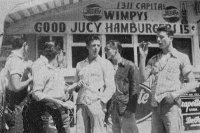
(The second boy from the right in the dark shirt is my buddy Pete
from the Settegast Park neighborhood and later, "The Setup". )
It stood on the corner of a Parking Lot directly across Capitol Avenue from the school's main entrance. You stood on the sidewalk to give your order through a window. above the narrow counter that extending across the front of the building. You ate anywhere you could squat down or sat on the fender of a car in the parking lot. Two hamburgers, a bag of chips and a soda pop cost thirty five cents. Hamburgers were fifteen cents each or two for a quarter.
III. Physical Education Classes
IV. Team Sports
V. The Auditorium
VI. The School Band
VII. Vocational Courses
VIII . War Heroes
IX. No Air Conditioning???
"Did something hit this wall?" she asks in a very accusing voice as she inspected our
wall and our ventilator shaft opening.
X. Our School
XI. PS, Pete's Hamburgers
PS, Old Pete or his wife could be seen behind the counter every morning, mixing something with their hands in a big dish pan. Most of us knew it was equal parts of ground up toasted stale bread and hamburger meat. How else do you think he could sell hamburgers for ten cents each or two for fifteen cents in the 1940's?
However . . . after thinking about it, it kind of makes you wonder about the little sidewalk hamburger stand next door to the Ritz theater, between Main and Travis on Preston avenue. They sold their hamburgers for a nickel apiece.
The End