
To Old Houston, Texas
Back When When I was a kid.
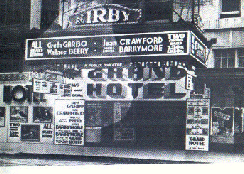
The Old Kirby Theater On Main Street (1940's)
The Big Ones Were The Great Depression
of the 1930's and WW II of the 1940's.

"The Good Ol' Days"
" I can still remember that a "Mint Julep" cigarette
was about the nastiest thing I had ever tasted. "
("Lubbock Elementary School")
I came down with the Yellow Jaundice in 1945. And was laid up for over four weeks. Now I have to admit that at that time we only lived 2 miles from downtown and the Medical Arts building where Dr. Ormond's office was located, but when I first got sick, he drove out to our house to diagnose my problem. Not only that, but he made about 6 or 8 more house calls before I got well. Really sick people didn't go to the doctor in the "good old days", the doctor came to them.
I thought maybe it was because we lived fairly close to the downtown area, but Nellie remembered when her sister had pneumonia during that same time period, old Dr. Pickard came from his office on Washington Ave. near Shepherd Dr., out to their house on house calls to treat her. At that time they lived near the present Aldine High School on I 45, about 15 miles from downtown.
One night when I was real young and spending some time with grandma up in Montgomery, I had the misfortunate to have a wood splinter break off in my foot. It was just deep enough so it couldn't be removed with tweezers. Grandma placed a little piece of fat bacon on my foot, over the splinter and tied it on tight with some strips of rag. The next morning, after she woke me up, she untied the rag and there laying on the piece of bacon was the wood splinter, out of my foot.
Then there was the night when I was moaning and whimpering with a bad headache at bed time and grandma was out of aspirin. She got the jar of Vicks salve and rubbed my forehead with the salve. I never was sure if it cured the headache or the stinging sensation made me forget it, but I went to sleep. I've used the Vicks salve headache cure more then once, since then and it always helped.
And last, but certainly not least, there was coal oil and turpentine. For you younger people, coal oil is the old timey name for kerosene or for the real young people it's called lamp oil at Wally World (That's Wal-Mart to y'all citified ones). It was the favourite cure for all kind of cuts and abrasions. Cut your foot and someone would stick it in a pan of kerosene. Turpentine was used interchangeably with kerosene, but was more expensive and usually bought in small bottles or cans where kerosene was kept in most homes in gallon jugs or 5 gallon cans to refill the coal oil lamps and coal oil cook stoves. Turpentine was also often mixed with a spoon of sugar and taken as a tonic.
I remember the day Nellie stepped on a nail and the older lady down the street made her soak her foot and the puncture wound in a pan of turpentine. Later, we went to the doctor to get her a Tetanus shot. After hearing about the turpentine the doctor put his hands on his hips and said, �When in the world are you people going to get it in your heads that turpentine is used to thin paint, not to cure wounds.�
Before I quit talking about doctors and such I have to say something about my uncle Harry Legrande Milam. My grandmother was so impressed with her Doctor over the years that when Harry was born in 1915 that she named him after old doctor Legrande, who had delivered him. I guess a lot of people did things like that back in those days.
But the story didn't exactly end there. On October 26, 1918 grandpa Harry Lee Milam died, one of the thousands of victims during the big influenza epidemic of 1918. Old doctor Legrande was also the doctor who was taking care of Harry Lee when he died.
Uncle Harry Legrande was only three years old when grandpa died, but grandma was so upset because Doctor Legrande didn't save grandpa's life that she changed Uncle Harry's name. From that time until Uncle Harry died at 67 years old in 1982 his name was Harry Wesley Milam.
Can you believe that libraries were a large part of many young people's life during the time of "The Big Ones" and helped to form lifetime habits. Yes libraries, those big buildings full of books. Kids visited them of their own freewill and depended on them for a large part of their entertainment. Believe it or not, TV was a only a dream in the minds of a few inventors until about 1939 and TV wasn't available in the Houston area until the early 1950's. Even after that, if you could afford such an extravagance, there was only one channel and it only broadcasted a few hours a day.
Radio was a popular entertainment for some, however not everyone could even afford a radio back then. Many families who did have one rationed their use. I remember staying at my grandparents house in Montgomery, Texas. The radio was turned on at 12 noon and 6:00 PM for 15 minutes each time in order to hear the days news. That was it and even as a teenager I wasn't allowed to listen to the afternoon programs like "Little Orphan Annie", "Jack Armstrong", "Dick Tracy", Terry and The Pirates" and others that I always listened to when I was at home in Houston. Grandpa was worried about the added expense on the electric bill. Now don't laugh, Nellie remembers when her grandpa wouldn't let grandma go in the car with him most of the time because the extra weight would make the car burn more gasoline and they couldn't afford it.
Movies were another source of entertainment for the kids, especially the Saturday morning "Kiddies Shows". The norm for a "Kiddy Show" was the movie, a chapter of the current serial and about 4 cartoons and/or comedies. The only drawback to that was the ten cent admission price for movie tickets was pretty hard to come by. You have to remember that many family men of that time worked for 10 or 15 cents an hour. Dad was lucky, he made about 20 dollars a week putting in 85 or 90 hours a week. But, he was an exception being a professional man, a pharmacist. Oh yes, he did get an hour off to go home for lunch every day.
That didn't leave very many opportunities for entertainment for young people except books and the Houston Public Library was free for everyone to use. I fell in love with the Houston Public Library while I was in Elementary School. Every other week their "Book Mobile" parked in front of old Lubbock Elementary School and the teachers would march their students out to browse a little while and check out books. That's when I discovered the "Doctor Dolittle" series and became lost in the world of fantasy. I soon discovered Juiles Verne and H.G. Wells and other science fiction writers. Of course I also read the standards like "Tom Sawyer", Huckleberry Finn" and "Penrod". I have seen a lot of kids thumb through the pages of a book and complain, "But, there aren't any pictures." But, a real reader has no problem what so ever seeing the pictures using a term I coined called "Mind Graphics".
Any author worth his salt begins with a verbal description of the main character, such as "Corky was a few inches less then six feet tall and a little overweight, well more then a little. He stood out in a crowd with his bushy white mustache beneath the old timey metal frameless glasses and salt and pepper colored hair." Now think about it and you should see in your mind, the same picture that you see at the top of this column. Then there are descriptions of the room Corky is in, the street he is driving down and even the mud spattered lime green 1954 Chevrolet coupe with the dented left rear fender that he is driving. As you read these pictures usually form in your mind each time you read about Corky or his car. Now, it doesn't work if you only read the first page or two and give up.
Then when the 3 month summer vacation came along, I wondered what I would do for books to read. Sometime during the first week or so of summer vacation, I went outside and there it was. The Bookmobile was parked across the street, beside Settegast Park with it's load of books. The bookmobile came to the park every other week for the whole summer.
Now even at 73 I still visit the Waller County Library at least 2 or 3 times a month to check out 2 or 3 books. I have belonged to the Science Fiction Book Club off and on for the past 30 or so years and I would estimate that I currently have somewhere between 300 and 400 hardback Fantasy and/or Science Fiction books in my collection. I am also lucky enough to have a loving wife who understands a compulsive reader.
A funny thing happened while writing this story, I decided to go to the library in Hempstead Friday afternoon to take a couple of overdue books back. I was very surprised when I noticed that there wasn't any cars in the parking lot. Then I saw the sign on the door, "Closed Thursday, Friday, And Saturday For The Waller County Fair". You know you are living in a little country town when the entire Waller County Court House closes from 12:00 until 1:00 PM for lunch and the Waller County Library closes 3 days for the County Fair.
For those of you who haven't been paying attention, my old childhood neighborhood was the area around Settegast Park is in the near east side of Houston between Harrisburg Blvd. and Canal Street. We were 2 miles from Main Street downtown.
Education for the children in our area began at the old Lubbock Elementary school, located on the northwest corner at Sampson street at Harrisburg Boulevard. It was an old fashioned brick building with steel sliding boards fastened to all sides to be used as fire escapes. The building was Tee shaped, with the upper grades in the three story cross bar of the Tee at the front of the building. The first and second grades were taught in two story leg of the Tee that formed the back of the building. The auditorium and lunchroom were located in the leg and separated the 2 students sections.
I thought the first grade was the greatest thing going. We got to go outside and play during morning and afternoon recess and after we ate lunch. In my memory, most of the day was spent coloring and drawing and I was often chosen to take the blackboard erasers out by the incinerator and beat the chalk dust out of them. Somehow it didn't dawn on us that it was actually work thinly disguised as a privilege.
One of my earliest memories of a fun thing was winding the May Pole. Back in the 1930's May Day wasn't just a Communist Holiday and all the elementary schools held a May Fete celebration that was kind of like a school carnival.
It was only 5 city blocks from the park to the school so we all walked to and from school every day. Sometime if the weather was real bad mom would take me in the car. At that time dad was a pharmacist at the Lubbock Drug Store across the street from the school and he almost always walked to work. Actually, mom and dad always rented a house that was located close enough to dad's job that he could walk to work. In fact, many big city people in the 1930's made sure that they lived close enough to their job that they could walk to work.
I remember making that walk the morning of my first sin. I must have been about eight years old and was fascinated when I watched dad smoke a cigarette. One morning while getting ready for school I slipped a cigarette out of dad's pack and "Borrowed" a couple of kitchen matches out of the match holder in the kitchen. I remember that dad was smoking a brand of cigarettes named "Mint Juleps" at that time. They must have been one of the first menthol brand that came out.
After I got a couple of blocks from home it was time to show off how grown up I was becoming, so I pulled out my cigarette and lit up. Even now, I can still remember that a "Mint Julep" cigarette was about the nastiest thing I had ever tasted. After the first few puffs it was quickly thrown away and I decided to be a kid for awhile longer.
One the major sports for the boys at Lubbock Elementary was sneaking up the sliding board fire escape and sliding back down. Only the brave ones climbed all the way to the third floor. There was a sort of landing or level area at the second floor then down again making it a thrilling ride.
Teachers were always watching, to chase us off the fire escape slides. They didn't stand a chance of stopping us, but a piece of waxed paper did. One of the more adventurous boys found a waxed paper bread wrapper and discovered how much faster you could slide, sitting on waxed paper. I know, most of you are saying, say what, what is a wax paper bread wrapper. You see, plastic hadn't been invented way back then and all of the bakeries wrapped the bread in waxed paper.
Anyway, after a while that young fellow got bored and decided he would climb all the way up to the third floor and slide down the whole 3 stories. Fast. . . you wouldn't believe how fast he was sliding by the time he reached the flat area at the second floor. He was going so fast that he launched from the second floor landing and become airborne. He was airborne from the second floor flat section. He flew over the entire slide section from the second to the first floor and landed on the flat area at the bottom. His broken ankle ended the sliding board fun and the rest of us were happy to play softball after that.
IV. Growing Up Around Settegast Park
Old Settegast Park in Houston's near east end was a comparatively small City Park. It was only 3 small blocks long and 1 block wide. When I say small city blocks, I mean small. There were only 4 houses on each side of the block with a house between them facing each side street, backed up to each other. We moved to 3008 Congress Avenue (later changed to Garrow Street), in the middle block, across the street from the park in 1933. I was only 5 years old at the time and we lived there until I was 19 years old, so I spent a lot of time in the old park.
Billy and Pete both lived a block down at the end of the park and Buck lived 3 or 4 houses behind Billy in the end block. We four were about the same age and pretty close and although we played with all the other boys, we stuck together.
This was a different age, you could almost say a different world. It was a long time before air conditioning and during the spring, summer and fall everyone's windows and doors were open to catch whatever breeze was available. Of course most people kept their screen doors hooked at night so someone didn't wander in while we slept. I think that one of the things I miss most about those time is having a house open to the breezes, sounds and smells from the outside. Here in Pine Island with our air conditioning going, double pane windows, venetian blinds and shade cloth curtain on the west window we can barely hear a vehicle in our little lane 20 feet from the house.
At night you could hear every sound in the neighborhood and pretty well knew what was going on near you. I remember one night when Mrs. Henry, who lived next door, happened to look over at the window and saw a head peeking in. Her scream sounded like an air raid siren in the night and everyone within a block knew someone was in trouble. A lot of men came outside with guns or bats to see if someone needed their help. Of course everyone was relieved to hear it was just a window peeper. It must have cured the peeper though, we never heard of him again.
I remember late in the evening when it grew close to supper time and Billy and I would be in his front yard. I would hear this long drawn out �J O H N N Y� coming from down the street. That was mama standing on our front porch calling me, to let me know it was time to come home and get ready for supper. Walking home, I could pretty well tell what all of the neighbors were having for supper. As you walked past a house, the smells from the cooking drifted out to the sidewalk and you had a little preview of their supper.
Across the street from Settegast Park was a wonderful place for a young boy to grow up during the great depression. Most of the kids had a pair of side walk roller skates and many had a bicycle toward the end of the depression, but not much else. The park had a concrete sidewalk all the way around the perimeter was great for skating. A row of oak trees circled the park just inside the sidewalk and there were a few Catalpa trees scattered around the middle behind the �park house� making plenty of shade. Directly across the street from our house to the east was the soft ball diamond and just to the west was the �park house�. The big open field making up the eastern half of the park, besides the softball diamond, was great for flying kites in the spring and model airplanes in the fall. It was also the area where we usually played touch football.
The west end of the park was the business end. Just west of the �park house� was an old concrete swimming pool that had been filled in until it was about 3 feet deep and they had put in a concrete floor. That was the most popular place to roller skate. We would have our own �Roller Derbies� or play roller skate hockey games. A set of swings and see saws was a little further down to the west. At the far west end of the park there was a pair of blacktopped tennis courts that had a basket ball goal at each end of each court. Near the tennis court, there was a football field with pipe goal posts.
The free �park show� every week attracted young and old alike from 3 or 4 blocks around the park.
V. The Little Duplex Apartment
I don't think I ever mentioned anything about the house we lived in. Actually, it was a duplex apartment, one half of a big house. It was almost a �shotgun house�, but not quite. It had a nice size living room, behind it a dining room, behind it a kitchen with a small breakfast room and a tiny screened porch with just enough room for a washing machine on one side and a set of double rinse tubs on the other side of the back door. And, behind the kitchen, was a small hall, a bedroom, bathroom and a closet.
We moved there when dad was a druggist and went to work for the Lubbock Drug store located at Sampson and Harrisburg. The drug store was only about 6 blocks from our house and dad could walk to work. In the �Good Ol' Days� many people tried to live within walking distance of their job. Even though we and most of our neighbors had a car, it cost money to use it on an everyday basis and any money for anything other then the real necessities was hard to come by in the 1930s. After paying $22.50 a month for rent and buying groceries and a few other necessities there wasn't much left.
The other half of the house was an exact mirror image of ours. Mr. Henry lived in that half of the duplex with his wife and 3 daughters. He was a city fireman and worked at the station on Sampson Street. It was a block closer then the drug store.
Our duplex was just the right size for mom and dad with a 5 year old son when we moved there in 1933. It got a little crowded a few years later when mother's brother, Harry Wesley �Sonny� Milam, lived with us for a while after he graduated from Allen Academy. Dad helped him get a job at the Walgreens Drug Company warehouse.
I thought it was great, having Uncle Sonny living with us. He got to sleep on a cot in the dining room. I remember him taking me to see the �Gulliver's Travels� movie when it came out in 1939. I also remember that he would come home every once in a while, long after our supper was over. He would cook himself a ham steak and some fried potatoes. Of course I had already eaten supper, but he would always share a little with me. That meant a lot to an 11 year old kid.
Uncle Sonny lived with us for about 6 months or so. He did so well at work, that the company offered to give him a promotion if he would move to Dallas and work at their warehouse there. Being young and single, he jumped at the offer and moved to Dallas. He did extremely well at the Dallas branch and soon got married and later went into business for himself.
Letting younger family members live with you until they got a start in life and letting the older, infirm members live with you until they passed on was a part of life back then. I also remember when the Henry's in the other side of the duplex had Mrs. Henry's brother Clinton living with them for awhile until he got a start. That made 3 adults and the 3 preteen girls living in a small 4 room duplex apartment for a while. There wasn't any such thing as nursing homes and when the elderly members got to old to take care of themselves, either the youngest kid or kids continued to live at home or the elderly member moved in with one of the children. It wasn't to unusual to see an aged grandmother and grandfather or even an aunt or two living with a family in the good ol' days.
After Uncle Sonny left it was just three of us again until 1943 when mama announced I was going to have a new little brother or sister. I turned 16 years old, 3 months after my new little sister, Neila was born. I was no longer an only child and our little house was never the same after that. I was very happy when she came into the family however, because mama and dad made their bedroom in the old dining room because it was bigger and made more room for the new baby. Then I had their old back bedroom all to myself. A young boy having a private room of his own was a little unusual back then, when most families had at least 3 or 4 kids.
�
VI. Remembering Life As A Baby
Do you ever just sit back and really think hard about what your earliest memories are. Believe me it gets harder as you get older and at 73 it's a whole lot harder. However since I am only 23 on the inside I still try.
It was a long time ago, but I remember many details almost like it was yesterday. Dad was a druggist and working at the Madings Drug Store (after 2 or 3 other name changes the company is now Eckards) on Eleventh Street and we lived at 111 West Tenth and a Half street, in the old Houston Heights. That's the block between Yale Street and Heights Boulevard. The little stucco duplex is still there and it's still the only house on that block.
I still don't think mom should have made such a big deal about it, but she did. You see, there was this little mom and pop type neighborhood grocery store up Yale St. in the next block. I went there with mom all the time when she bought things for our supper. There was this really nice lady who ran the store and she gave me a little piece of penny candy every time we visited the store. So anyway, on that particular day I was playing in the little front yard and the thought popped into my head that I wanted some of that candy. Well it wasn't that far from the house so I hopped on my trike and rode it down to the store. I hadn't realized it was Sunday and of course the door was locked and no one was there.
After sitting there a few minutes, I noticed that the park in the next block, across Yale Street, where mom and I went to play and I could see and hear the kids playing there. I rode my trike across the street and parked it beside the swing set and started swinging. I was having a pretty good time when Mr. Hawkings came up to me and ask if I was having fun. Mr. Hawkings was our landlord and lived in the big house beside ours at the corner of Tenth and a Half and Heights. He said it was time to go home and put me on the trike. He was nice and walked along with me.
Mom seemed real glad to see me when we turned the corner, but at the same time she let me know that she pretty mad. That was the day I learned that even as old as I thought I was you didn't ever leave the yard without talking to mom first. I realize now that at 2 years old I was a little young to be crossing Yale Street and going to the park alone on a little tricycle, but it seemed the thing to do at the time.
I also remember embarrassing mom while living there. Around the corner, in the other direction was a fire station. Mom, my grandmother and I were out walking one evening. In 1930, during the depression, walking in the evening was one of the few entertainment's that most people could afford. Anyhow, as we walked in front of the fire station, a bunch of the firemen were sitting around in front of the station. My toe caught a crack in the sidewalk and I fell face down on the sidewalk in front of them. I wasn't hurt, and when mom jerked me up I looked her in the eye and loudly said, "I fall down and go boom." I don't know if mom thought it was funny, but the firemen found it hilarious and almost laid down laughing. We walked back home along Heights instead of Yale.
After that we moved to a house at 533 Cortlandt, which was still in the Heights. I was allowed to play in the back yard all I wanted to. The thing that sticks out in my mind about that house was the gigantic fence around the back yard. It must have been twice as tall as me. I went by that house a few years later and wondered how they shrunk the fence down to four feet high. Of course it dawned on me that I must have been about two feet tall when we lived there. But even now, in my mind I can still see the top of that fence way above my head.
I may have been 3 or 4 years old by the time we moved out to 1569 Telephone Rd. and dad worked across the street at Lenox Drug Store. The most memorable thing about that place was one night when mom and I were sitting on the couch looking across the street at the drug store where dad worked. I got bored and picked up a small silver salt shaker and started fiddling with it. About that time I noticed the lamp beside the couch had one empty socket. The silver salt shaker fit in the hole just right. There was a big sputter, sparks flying and the house was dark. Dad sent the delivery boy over to replace the fuse. And except for a hole in the salt shaker and a couple of scorched fingers, we were back to normal.
VII. Building Boats
Even when I was very young I loved to fish. The first attempts I remember was a very small pond (mud hole) Maybe 20 feet or so across and a foot or two deep. It was over off Commerce Street where the railroad track made a Y. The pond was really a low spot in the fork of the Y. Now I was only fishing for crawfish, but it was fishing. Like all novice fishermen I knew you needed to get out in the middle of a lake to be able to fish where the big ones were. Somewhere I found an old piece of corrugated tin roofing about six feet long and it was the answer to my prayer.
I folded the corners at one end together with a piece of two by four inside making it look like the front of a boat. Then I did the same thing at the other end. A board nailed crossways between the sides at the center to hold the sides apart made it into a small canoe. Leaky yes but a canoe. In those days utility poles were coated with tar which softened and ran a little in the summer forming small balls of tar on the pole. The small balls of tar not only made a poor substitute for chewing gum, they also sealed the ends the ends of a tin canoe. That was when I first learned that the middle of the pond isn't necessarily the best spot to catch fish (or crawfish).
After Nellie and I married, had a couple of boys and moved to the Humble area I still had fishing on my mind. By then I had graduated to casting artificial lures from the bank trying to find a bass who was stupid enough to think it was something good to eat.
Late in the evenings my brother-in-law, Pee Wee, and I would go over on Lake Houston Parkway just past where it joined C. E. King Parkway. There was a stretch about 10 city blocks long where the ditches were 15 or 20 feet wide and full of water on both sides of the road. There was a small creek that crossed under a bridge on the road about half way down the stretch of ditches. We would walk along the side, near the road and cast to the far bank. Once in a while we caught a bass, but more often we caught the barbed wire fence or one of the hundreds of trees and bushes on the other side of the ditchs. A working man with 3 kids between 5 and 12 can't afford to loose very many lures before he is out of the fishing business.
That's when Pee Wee and I decided to build a boat. I scrounged a couple of one by twelve boards about ten foot long and bought a sheet of quarter inch plywood. Pee Wee scrounged a gallon of industrial blue paint and some brass wood screws and we built an eight foot long flat bottom boat. It paid for itself the first trip when we picked about 20 or 30 lures and bait rigs off the fences, trees and bushes. You see there was always a dozen or so people fishing along that stretch and everybody lost lures and bait rigs. After that we would go about once a week and pick lures like picking grapes for an hour and then fish until dark. When I say bait rigs, I mean pyramid shaped lead sinkers that would cripple a man if one hit him. Three treble hooks about an inch across and leader material the size of weed eater line with bright red beads. I used to see people fishing with those bait rigs hanging from a rod the size of a broomstick and a reel big enough to pull a car. I always wondered what those fishermen and women expected to catch in a bar ditch.
On one pretty fall Saturday, Pee Wee and I decided to explore a little so we worked the boat under the fence on the south side and begin working our way down the little creek. It was beautiful, the creek was only about five or six feet wide with huge cypress trees growing along the banks and knees sticking up here and there. In only a couple of hundred feet we were alone in the wilderness. No traffic sounds or people talking. Nothing except the birds singing. After ten or fifteen minutes the creek begin to widen and we came to another barbed wire fence. After working the boat under the fence we discovered we were entering the top of a big lake. Son of a gun, we had discovered a hidden lake that would be the answer to a fisherman's dream.
We slowly paddled and fished our way further south on the lake for a half hour or so. Then I heard a car running across a wooden bridge. What a shock. It only took a few paddle strokes to come out of the trees. Then we could see the road crossing the middle of the lake in front of us. That's when we realized we were fishing in the north end of Sheldon Reservoir.
Letdown??? Yes, it was for a little while until we realized that it was late in the fall and Sheldon would be closed to fishermen until the next spring. That meant that back on the other side of the row of trees we were out of sight and out of mind.
VIII. Boys Are Builders
Not trying to be a sexist, but you reckon that there is anything to the belief that men and women are destined by their sex to act in certain ways? You know like males are destined to be builders and females to be homemakers. What got to thinking about this, was searching my childhood memories for the next story.
Some of my earliest memories of walking home from the old Lubbock Elementary School, are walking past the lumber yard. In those days lumber yards ripped rough lumber to finished size and threw the left over 8 to 12 foot long strips in a pile outside to be burned. I would go through the pile and pick out pieces I thought would be useful and drag them home as a free source of material to build things. I was always scrounging pieces of 2 by 4's and boards for projects. When I could get a dime I would go inside and buy a dimes worth of nails. I built everything from kites and sidewalk skate scooters to shacks for our gangs club houses.
WAIT NOW, I use the word "Gang" to mean a group of boys who played together, and not in the modern sense. Don't forget how the meanings of words change over the years. When I was young, being "Gay" meant that you were happy and most children were said to be "young and gay".
Our last clubhouse was a real winner. We built a frame work about 6 feet square and 6 feet high out of assorted pieces of 2 by 4 and 2 by 6 lumber against the back of a neighbor's garage. The garage wall formed the back wall of the club house, saving boards and it added stability to our building.
We enjoyed that project so much, that a few weeks later we decided to expand so we added a second story. By the time we finished the second floor, we realized that the club house, being about 50 or 60 feet back from the street was susceptible to attack from our enemies, since we couldn't see them coming. That problem was solved by building a platform up in the tree beside the club house, from where one of the club members could keep watch over the house.
That worked well except that we finally realized there was a blind spot across the rear of Pete's house. We solved that problem when we discovered a 20 foot length of 2 inch pipe. It fit exactly between our tree platform and a tree about 20 feet further toward the rear of the property. With an old piece of rope stretched between the trees, a few feet above the pipe to serve as a hand rail, we could scurry between the trees without coming down to the ground.
Our final addition was the basement. We built a bench with a solid front across one wall. The seat was hinged and the floor boards below the bench were removed. We dug out below the floor until we had enough open space for a couple of boys to hunker down under the floor. That way if we had a warning that any of our enemies were in the immediate vicinity, one or two of us could hide in the "Basement" and listen to their plans while they were in our clubhouse.
Now, I am sure that some of you may think our security measures were somewhat extreme, but I can honestly say that with our security system, we were never attacked or taken by surprise. Some of the more suspicious readers of this column may suspect that our enemies (whoever they were) didn't know the part they were to play, but we didn't take chances.
After Nellie and I were married, I discovered a frame shop on Fulton St. near the old textile mill that had a pile of scraps. I remember building a picket fence, porch swing and trellis among other things while we lived on Firnat St. .
After we moved to the Humble area, in the next 40 years I built a chicken house, an 8 by 12 foot wash house, an 8 by 12 addition to the wash house with a second story, a 12 by 16 foot building with a clear plastic roof and south side to serve as a green house that was later converted to a shop building, an 8 by 8 foot wood shed and a 12 by 24 lawn mower repair shed. Hey, I almost forgot the 16 by 30 foot addition to the house, another later 8 by 12 foot addition, the 6 by 32 foot covered front porch and the 12 by 24 foot attached carport .
Now since I'm in my 70's and we had the house moved to Pine Island a couple of years ago, I've had to slow down. Well, I did build the 12 by 16 foot room addition to the house and the 8 by 32 foot covered back porch and the new chicken house.
The funny thing is that in my entire working life I never had a job that was related to any type of building or construction. Nellie says I am not hard to buy for, she can just buy me a pile of two by fours.
Even funnier, I just lifted my head and looked out the front window. There sits the 16 by 24 foot little store building with the 6 foot covered porch across the front that I built about 5 years ago.
VIII. Pig Latin
Ifyay ouyay underyay tandsay isthay inelay, ouyay areyay obablypray olderyay enthay ouyay antway otay adimityay.
It says, �If you understood this line, you are probably are older then you want to admit.� You could figure out the written version after a little while, but the same sentence spoken is much harder to understand.
During the 1930's and 1940's it was a language spoken by almost every kid in the United States. �Pig Latin� was a fabricated, imaginary language usually spoken by kids for two reasons. One, it was a way to talk to their friends, without grownups understanding every word. Two it was a way for kids in the know to talk to each other and exclude those not in the know.
I can still remember my first introduction to Pig Latin. Some smart alec kid was calling me an �iggerbay oneyay'. I didn't have any idea what he was saying, but I remember I was strongly considering popping him in the mouth because it didn't sound like anything I wanted to be. By that age however, a boy growing up around Settegast Park, had already learned that popping someone in the mouth often led to getting your own mouth popped and maybe worse. So instead, I quickly found someone who was �bi-lingual� in Pig Latin and English and learned how to speak it myself. Looking back now I guess I really was a Iggerbay Neoay compared to him.
Although Pig Latin is a created for fun language, it still has rules of grammar like any language.
First, if a word starts with a constant and a vowel, put the first letter of the word at the end of the word and add "ay." For instance the word Happy = appyH + ay = appyHay.
Second, if a word starts with two constants move the two constants to the end of the word and add "ay." For instance the word Child = Ildch + ay = Ildchay.
Third, if a word starts with A, E, I, O, or U you would just add �yay� to the end. For instance the word Add=Add+yay=Addyay. Different regional dialects added �hay� or �way� instead of �yay�.
Oh yes, one more thing about Pig Latin, it can be used with almost any other base language besides English like anishSpay, ermanGay or enchFray for example.
T h e C o n t e n t s
I. Doctors Actually Came To Your House
II. Reading And Libraries
III. Lubbock Elementary School
The End